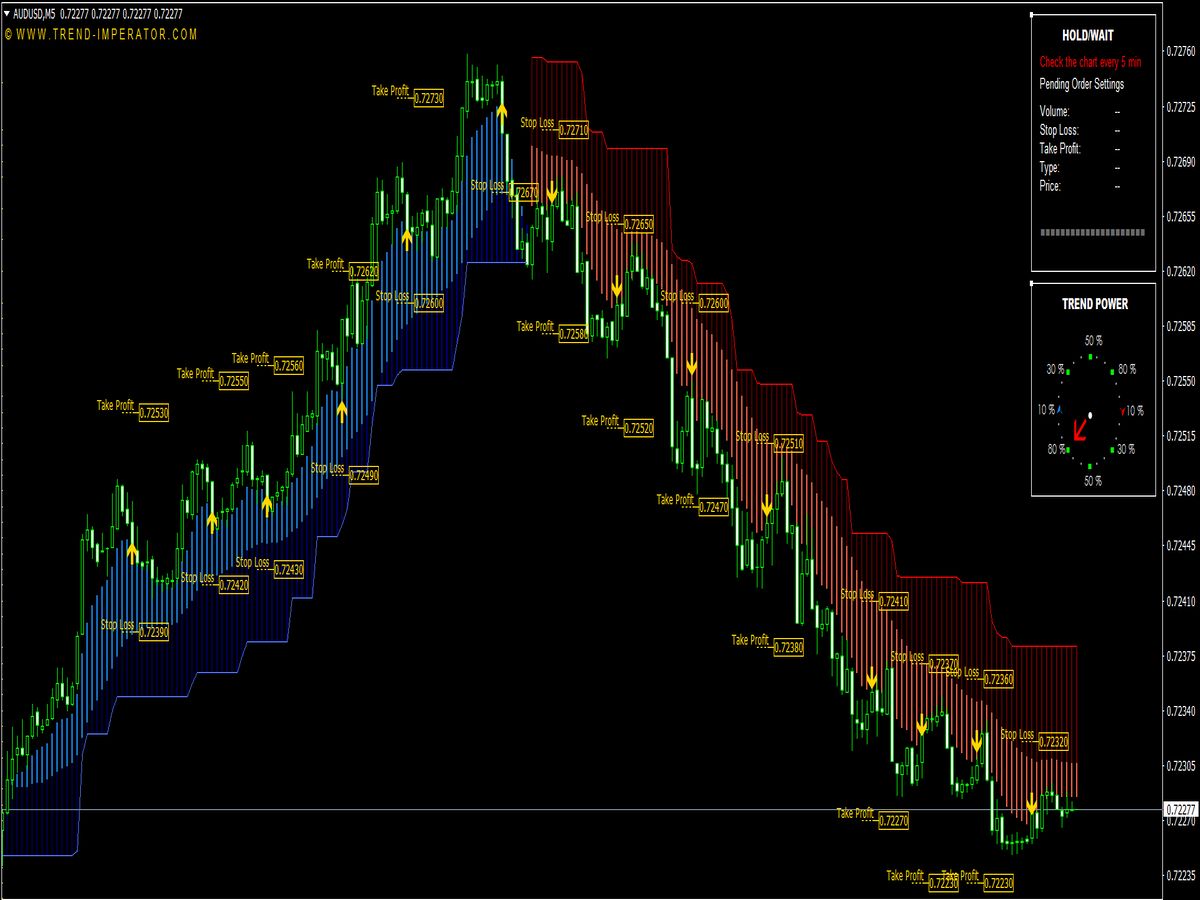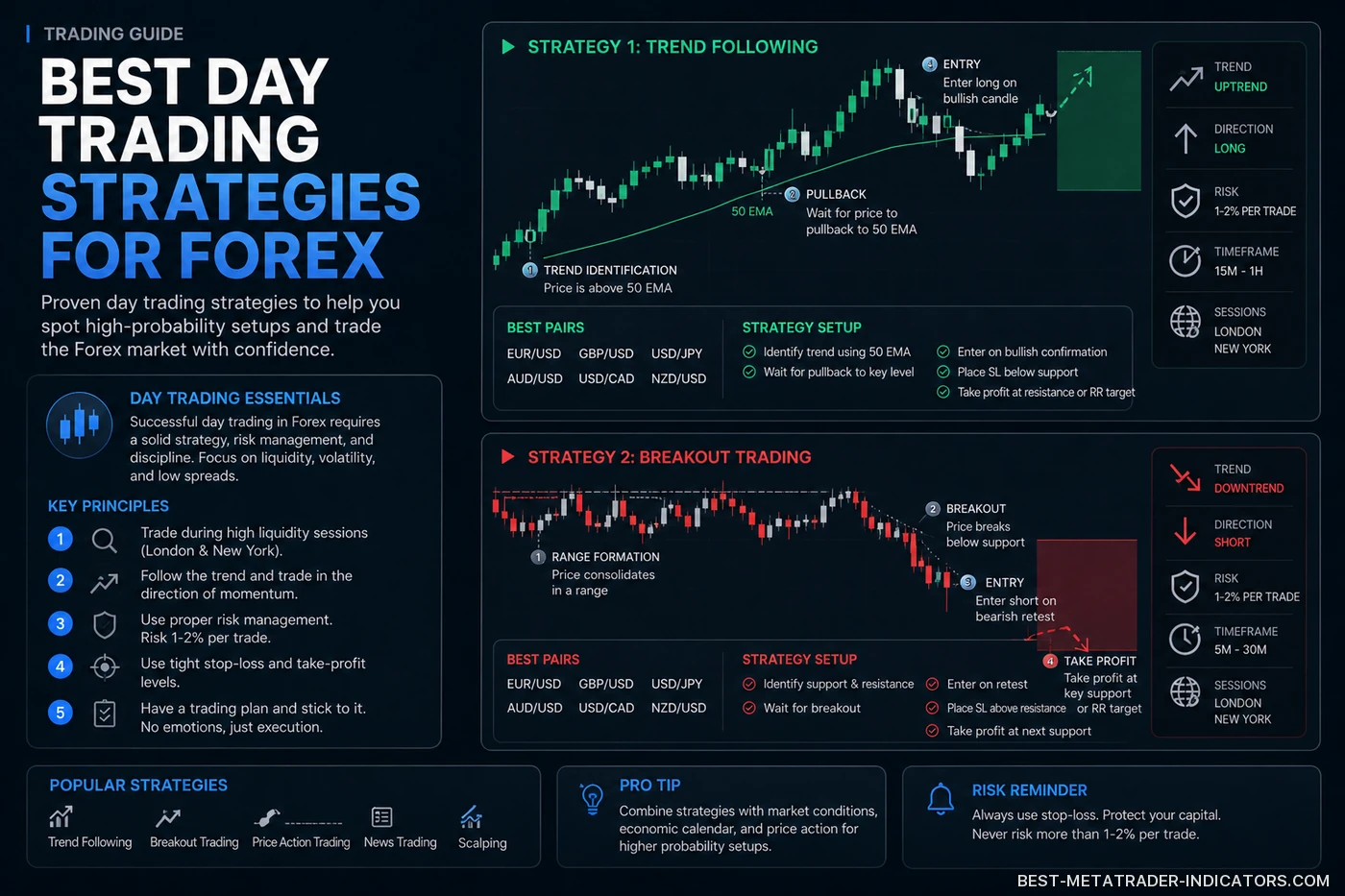
Forex day trading is one of the most popular approaches in the currency market because it allows traders to open and close positions within the same trading day. The aim is not to react to every flicker on the chart, but to capture clean, high-probability intraday moves when liquidity, structure and momentum line up.
After many years around active markets, one lesson becomes hard to ignore: the best day trading strategy is rarely the one with the most indicators. It is the one you can read clearly, execute consistently, manage emotionally and protect with disciplined stop loss and take profit rules.
📌 What Is Forex Day Trading?
Forex day trading is a short-term trading style where positions are usually opened and closed within the same trading session. Traders focus on intraday price movements in currency pairs such as EUR/USD, GBP/USD, USD/JPY, AUD/USD and XAU/USD if their broker offers gold trading.
Unlike swing traders, day traders do not usually hold trades overnight. This keeps the focus on visible intraday structure, active sessions and controlled execution. It also means that timing, discipline and emotional control become just as important as the setup itself.
Professional note: Day trading is not about trading all day. The best setups often appear during specific windows, such as the London open, the New York open or the London-New York overlap, when price tends to move with better rhythm and cleaner follow-through.
⚙️ Core Principles Before Choosing a Strategy
Before selecting a forex day trading strategy, every trader should define a clear framework. A strategy without rules becomes guesswork, and guesswork is expensive in leveraged markets.
🎯 Market Selection
Focus on liquid pairs with tight spreads and consistent intraday movement. Major pairs are usually better for newer traders because they offer cleaner execution, lower transaction costs and more reliable technical reactions around key levels.
🛡️ Risk Control
Risk a small fixed percentage per trade. Many experienced traders keep risk between 0.25% and 1% per setup, then adjust position size around the stop loss instead of moving the stop to fit the lot size.
⏰ Trading Window
Trade when liquidity is active and the chart has room to move. Avoid forcing trades during dead market hours, because spreads can matter more and price movement often becomes choppy, thin and unreliable.
🚀 1. Breakout Trading Strategy
The breakout strategy aims to capture strong price movement when the market breaks above resistance or below support. This approach works best when price has been compressing inside a clear range and volatility starts expanding through a level that other traders are watching.
How It Works
- Identify a clear range, support zone or resistance zone.
- Wait for price to break the level with strong momentum.
- Confirm the breakout with candle close, session timing, ATR expansion or a visible increase in directional pressure.
- Enter after the breakout or on a retest of the broken level.
- Place the stop loss inside the previous range or beyond the invalidation point.
Best use case: Breakout trading is especially useful around active session opens and after tight consolidation, when the market has built up enough pressure to move beyond a well-defined support or resistance zone.
Common mistake: Many beginners enter the first spike without waiting for confirmation. False breakouts are common, especially when price pushes through a level, triggers stops and then snaps back inside the range.
🔁 2. Pullback Trading Strategy
The pullback strategy is one of the most reliable forex day trading methods because it allows traders to join an existing trend at a better price. Instead of chasing momentum after the move is already extended, the trader waits for price to retrace into a value area.
Popular Pullback Tools
- Moving averages such as the 20 EMA or 50 EMA
- Fibonacci retracement zones
- Previous support and resistance levels
- VWAP or session average price where available
- Trendline retests
✅ Bullish Pullback Idea
Price is making higher highs and higher lows. Wait for a retracement into support or an EMA zone, then look for bullish rejection candles, a break of minor structure or momentum confirmation before risking capital.
✅ Bearish Pullback Idea
Price is making lower highs and lower lows. Wait for a retracement into resistance, then look for bearish rejection, a liquidity sweep above a minor high or renewed continuation momentum.
📈 3. Trend-Following Day Trading Strategy
Trend-following is built on a simple principle: markets often continue in the direction of dominant momentum longer than traders expect. The goal is to identify the intraday trend and trade only in that direction, rather than trying to call every turning point.
Simple Trend Filter
- Price above the 50 EMA: bullish bias
- Price below the 50 EMA: bearish bias
- Higher highs and higher lows: uptrend
- Lower highs and lower lows: downtrend
- Flat moving averages: avoid trend strategies
Trader tip: The cleanest trades often come from working with the higher-timeframe direction. Use the 15-minute or 1-hour chart for context, then refine entries on the 5-minute chart with MetaTrader indicators such as EMA, ATR and RSI kept simple.
⚡ 4. Scalping Strategy
Scalping is a fast day trading technique where traders aim to capture small price movements repeatedly. This strategy requires tight spreads, quick execution, strong focus and emotional discipline, because one impulsive decision can wipe out several small wins.
Scalping Rules to Consider
- Trade only during high-liquidity sessions.
- Use major pairs with tight spreads.
- Avoid entering when the spread is wide or candles are erratic.
- Take profits quickly and avoid turning scalps into swing trades.
- Set a daily loss limit and stop trading once reached.
Important: Scalping can be profitable, but it is not suitable for everyone. Transaction costs, slippage, fast candles and emotional pressure can quickly expose a weak plan.
🧠 5. Price Action Strategy
Price action trading focuses on reading the market without relying heavily on indicators. Traders analyze candles, support and resistance, liquidity zones, market structure and momentum shifts to understand where buyers or sellers may be losing control.
Key Price Action Signals
- Pin bars: rejection from a key level
- Engulfing candles: momentum shift
- Inside bars: consolidation before expansion
- Break of structure: trend continuation or reversal clue
- Liquidity sweep: stop hunt before a reversal
📍 Example Setup
EUR/USD approaches a previous intraday support level. Price sweeps below the level, rejects quickly and closes back above support. A trader may look for a long entry after confirmation, with the stop loss below the sweep low.
🎯 Why It Works
Price action helps traders understand where trapped traders may be positioned. Once liquidity is taken and price returns back through the level, the market can reverse sharply if momentum shifts.
📊 6. Volatility Expansion Strategy
Volatility expansion trading focuses on the moment when a quiet market starts to move with range, speed and cleaner candle closes. Instead of reacting to external events, the trader reads the chart itself: compression, breakout pressure, ATR behavior, candle body size and whether price holds outside the previous range.
Technical Volatility Clues for Forex Day Traders
- ATR rising after a low-volatility squeeze
- Candles closing outside a tight range
- Retest of the broken support or resistance level
- EMA slope turning in the breakout direction
- RSI holding above or below the midpoint during continuation
- Clean higher lows or lower highs after the initial break
Risk warning: Volatility can look attractive, but wide candles also increase stop distance and slippage risk. Beginners should avoid chasing the first candle and instead wait for structure, a retest or a clear invalidation point.
📊 Strategy Comparison Table
Use this comparison to match a forex day trading strategy with your personality, schedule and risk tolerance.
| Strategy | Best Market Condition | Timeframe | Difficulty | Trader Profile |
|---|---|---|---|---|
| Pullback TradingTrend continuation entries | Trending market | 5m, 15m, 1h | Patient and selective traders | |
| Breakout TradingVolatility expansion | Range break or session open | 5m, 15m | Momentum traders | |
| ScalpingFast execution | High liquidity | 1m, 3m, 5m | Experienced active traders | |
| Price ActionClean chart reading | All conditions with structure | 5m, 15m, 1h | Discretionary traders | |
| Volatility ExpansionCompression into movement | Range expansion after squeeze | 1m, 5m, 15m | Advanced risk managers |
🧾 Forex Day Trading Checklist
A checklist keeps traders objective. Before entering any forex day trade, confirm that the setup meets your predefined conditions and that the stop loss, take profit and trade size are already decided.
| Checklist Item | Question to Ask | Status |
|---|---|---|
| Market bias | Is the intraday trend clear? | Required |
| Key level | Is price reacting at support, resistance or liquidity? | Required |
| Entry trigger | Do I have confirmation, or am I guessing? | Required |
| Stop loss | Is my invalidation point logical? | Required |
| Reward-to-risk | Is the trade worth the risk? | Required |
| Volatility filter | Is the current range suitable for my stop and target? | Recommended |
💰 Risk Management Rules for Day Traders
No forex day trading strategy can survive poor risk management. Even a strong setup will have losing trades. The difference between professionals and amateurs is how losses are controlled and whether the trader respects the level that proves the idea wrong.
✅ Smart Risk Rules
- Risk only a fixed percentage per trade.
- Use a stop loss on every position.
- Define a maximum daily loss.
- Avoid increasing lot size after losses.
- Journal every trade with screenshots.
❌ Dangerous Habits
- Moving the stop loss further away.
- Revenge trading after a loss.
- Overtrading during quiet sessions.
- Ignoring spread, candle size and volatility.
- Using excessive leverage.
🕒 Best Times to Day Trade Forex
Timing matters. The forex market is open 24 hours a day during the trading week, but not all hours are equal. The best technical opportunities usually appear when liquidity and volatility are high enough for price to respect levels and travel toward targets.
| Session | Characteristics | Best For |
|---|---|---|
| Asian Session | Often slower, range-bound movement | Range trading and JPY pairs |
| London Session | High liquidity and strong directional moves | Breakouts and trend trades |
| New York Session | Active movement and frequent momentum shifts | Momentum and structure-based setups |
| London-New York Overlap | Highest liquidity period for many major pairs | Breakouts, pullbacks and trend continuation |
🧩 Building Your Own Day Trading Plan
A trading strategy becomes powerful only when it is converted into a complete trading plan. The plan should remove emotional decisions and make execution repeatable, especially when price moves quickly and the temptation to improvise is strongest.
Simple trading plan template: Pair selection, session, timeframe, market bias, entry trigger, stop loss rule, take profit rule, maximum daily risk, maximum number of trades and post-trade journal routine.
Example Day Trading Plan
- Pairs: EUR/USD and GBP/USD only
- Session: London open and New York overlap
- Timeframes: 1-hour for bias, 15-minute for setup, 5-minute for entry
- Strategy: Trend pullback into support or resistance
- Risk: 0.5% per trade
- Daily stop: Stop trading after two full-risk losses
- Journal: Screenshot before entry, after exit and end-of-day review
📓 Trading Journal Notes
A trading journal is one of the most underrated tools in forex. It reveals whether your edge is real, whether you are following your rules and which mistakes are costing the most money.
📝 Record the Setup
Write down the strategy used, market condition, session, entry reason and higher-timeframe bias.
📷 Save Screenshots
Capture the chart before entry, during management and after exit to review your decision-making objectively.
🔍 Review Weekly
Look for repeated mistakes, best-performing pairs, most profitable sessions, stop loss placement quality and emotional patterns.
🚫 Common Forex Day Trading Mistakes
Many traders fail not because they lack strategy, but because they repeat the same behavioral mistakes. Avoiding these errors can improve performance immediately, especially when the trader already has a workable technical method.
- Overtrading: Taking low-quality setups because of boredom.
- Ignoring spreads: Especially during thin conditions and fast volatility.
- No daily stop: Continuing to trade after emotional damage is done.
- Changing strategies too often: Never allowing one method enough time to prove itself.
- Trading against strong momentum: Trying to pick tops and bottoms without confirmation.
- Poor preparation: Starting the session without marked levels, bias and risk limits.
🏆 Which Strategy Is Best for Beginners?
For most beginners, the pullback strategy is often easier to learn than scalping or aggressive volatility trading. It teaches market structure, patience, trend direction and risk placement. Breakout trading can also be useful, but beginners must learn to avoid false breakouts.
Beginner recommendation: Start with one or two major pairs, one trading session and one strategy. Mastering one repeatable setup is far more valuable than knowing ten strategies superficially.
❓ Forex Day Trading FAQs
What is the best forex day trading strategy?
There is no single best strategy for everyone. Pullback trading, breakout trading and price action strategies are among the most practical approaches when combined with strict risk management.
Can beginners day trade forex?
Yes, but beginners should start slowly, use a demo account first, trade small size and focus on one strategy until they can execute it consistently.
How many trades should a day trader take?
Quality matters more than quantity. Many disciplined day traders take only one to three good trades per session instead of forcing constant activity.
Which forex pairs are best for day trading?
Major pairs such as EUR/USD, GBP/USD and USD/JPY are popular because they usually have strong liquidity, tight spreads and reliable intraday movement.
Is scalping better than day trading?
Scalping is a form of day trading, but it is faster and more demanding. It may suit experienced traders, while beginners often do better with slower intraday setups.
Do indicators work for forex day trading?
Indicators can help, but they should not replace price structure, risk management and market context. Simple MetaTrader-compatible tools like moving averages, ATR and RSI can be useful when applied consistently.
✅ Final Thoughts
The best day trading strategies for forex are not magic formulas. They are structured methods for reading price, managing risk and executing with discipline. Breakouts, pullbacks, trend-following, scalping, price action and volatility expansion can all work — but only when matched with the right trader personality and market condition.
If you are serious about forex day trading, keep your process simple: choose one strategy, trade during liquid sessions, risk small, journal every trade and review your performance weekly. Consistency is built through repetition, not prediction.
Disclaimer: Trading forex and CFDs involves risk and may not be suitable for every trader. This article is for educational purposes only and does not provide financial advice, investment recommendations or a guarantee of future results.