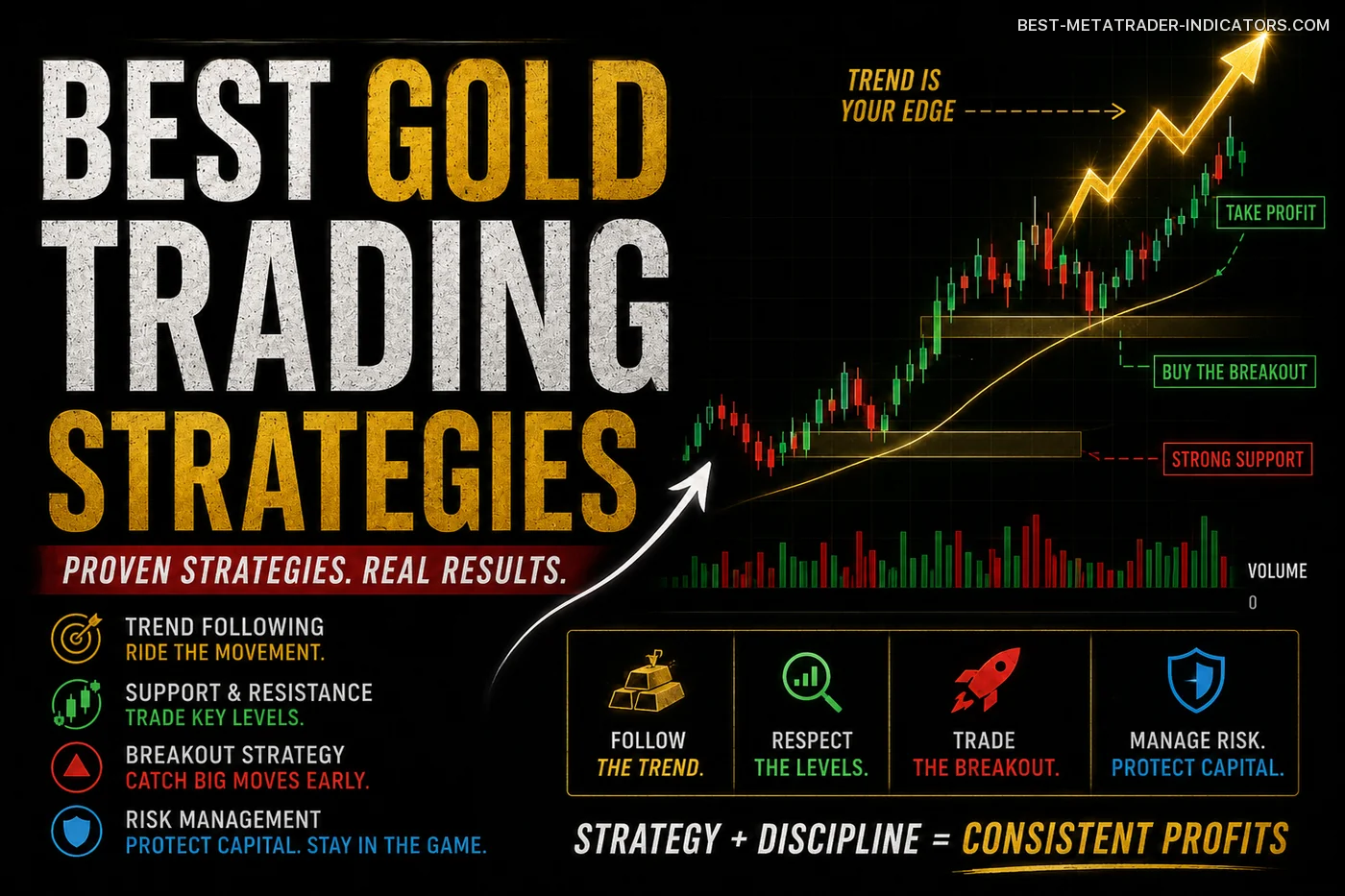
Gold is not just another forex pair. XAU/USD can move aggressively, reject levels with precision, expand fast from liquidity zones, and punish traders who enter without a structured plan. The best gold trading strategies combine market structure, price action, liquidity, volatility, risk control, and clean execution.
This guide explains practical gold trading strategies, entry ideas, confirmation tools, checklists, comparisons, common mistakes, and FAQs for traders who want a professional technical framework instead of random signals.
🏆 Why Gold Is Popular Among Forex Traders
Gold is one of the most actively traded instruments among technical traders. In the forex market, traders usually trade it as XAU/USD, which means the price of gold quoted against the U.S. dollar. Gold attracts attention because it often creates clean intraday ranges, strong breakouts, sharp pullbacks, and clear reactions around important support and resistance zones.
Volatility
Gold can create strong intraday moves, making it attractive for day traders and scalpers who wait for clean setups.
Liquidity
XAU/USD usually offers deep liquidity, especially during the London and New York sessions.
Technical Precision
Gold often reacts clearly around previous highs, previous lows, trendlines, moving averages, and supply or demand zones.
Trader’s note: Gold can be very technical, but it is also very fast. A clean chart setup still needs confirmation because a single impulsive candle can easily trap early entries.
📌 What Moves Gold Price Technically?
Before choosing a gold trading strategy, understand the technical forces behind XAU/USD movement. Gold often moves because price is reacting to liquidity, imbalance, trend pressure, failed breakouts, or a shift in market structure.
| Technical Driver | Typical Impact on Gold | Trading Note |
|---|---|---|
| Liquidity Zones | Price often sweeps previous highs or lows before reversing or continuing. | Watch obvious swing points and session extremes. |
| Market Structure | Higher highs and higher lows support longs; lower highs and lower lows support shorts. | Important for trend and swing traders. |
| Volatility Expansion | After compression, gold can break strongly once momentum enters the market. | Be careful around tight ranges and breakout candles. |
| Support and Resistance | Clean zones can create strong reactions, retests, and continuation setups. | The best zones are obvious on higher timeframes. |
| Moving Average Pressure | Dynamic support or resistance can guide trend pullbacks. | More relevant when price is trending cleanly. |
📈 Strategy 1: Trend Following Gold Strategy
The trend-following strategy is one of the most reliable gold trading approaches when XAU/USD is moving strongly in one direction. Gold often creates powerful trends after clean breakouts, structure shifts, or strong momentum from a major technical zone.
How to Trade It
- Identify the trend on the 4H or daily chart.
- Use moving averages such as the 20 EMA, 50 EMA, or 200 EMA to define direction.
- Wait for a pullback into a dynamic support or resistance area.
- Look for bullish or bearish rejection candles.
- Enter only after confirmation, not during emotional spikes.
Best use: This strategy works well when gold is making higher highs and higher lows in an uptrend, or lower highs and lower lows in a downtrend.
💧 Strategy 2: Liquidity Sweep and Reversal Strategy
Gold frequently hunts liquidity above highs and below lows before reversing. Many retail traders place stop losses at obvious levels, and larger orders often appear around these zones, creating sharp reactions and fast directional shifts.
Bullish Liquidity Sweep
Price breaks below a previous low, triggers stops, quickly rejects the level, and closes back above support. This can signal a potential long setup.
Bearish Liquidity Sweep
Price breaks above a previous high, grabs liquidity, fails to hold above resistance, and closes back below the level. This can signal a short setup.
Confirmation idea: Do not enter only because price sweeps a high or low. Wait for displacement, a market structure shift, or a strong rejection candle.
🔥 Strategy 3: Breakout and Retest Strategy
The breakout and retest strategy is popular because it gives traders a logical entry after price confirms a new direction. Instead of chasing the breakout candle, patient traders wait for price to return to the broken level.
Breakout Retest Rules
- Mark a clear support or resistance zone.
- Wait for a strong candle close beyond the zone.
- Avoid weak breakouts with long wicks and no follow-through.
- Wait for price to retest the broken level.
- Enter after rejection or continuation confirmation.
- Place the stop loss beyond the retest zone.
Warning: Gold often creates false breakouts. A breakout without momentum, displacement, or a strong candle close is not enough.
⚡ Strategy 4: London and New York Session Strategy
Gold often becomes more active during the London and New York sessions. The overlap between these sessions can bring strong movement because liquidity increases and short-term traders react quickly to breakouts, sweeps, and retests.
| Session | Gold Behavior | Best Strategy Type |
|---|---|---|
| Asian Session | Often slower, but can create ranges and liquidity levels. | Range marking and preparation. |
| London Open | Can create the first major directional move. | Breakout, fakeout, liquidity sweep. |
| New York Open | High volatility, especially when price reaches important intraday levels. | Momentum, reversal, volatility-control strategy. |
| London-New York Overlap | Often the strongest liquidity window. | Trend continuation and intraday setups. |
🧠 Strategy 5: Support and Resistance Strategy
Support and resistance levels are still among the most useful tools for gold traders. The key is to avoid drawing too many levels. Gold responds best to clean, obvious zones that are visible on higher timeframes.
Strong Support Zone
A level where price previously rejected lower prices multiple times, ideally with strong bullish reaction candles.
Strong Resistance Zone
A level where price repeatedly failed to continue higher, especially if the zone aligns with previous highs or supply areas.
For higher-quality setups, combine support and resistance with trend direction, liquidity, candle confirmation, and session timing.
📊 Strategy 6: Moving Average Pullback Strategy
Moving averages help traders filter market direction and avoid trading against the dominant trend. In strong gold trends, price often pulls back into the 20 EMA or 50 EMA before continuing.
Example Setup
- Price is above the 50 EMA and 200 EMA.
- The 50 EMA is above the 200 EMA.
- Price pulls back toward the 20 EMA or 50 EMA.
- A bullish rejection candle appears.
- Entry is taken after confirmation with stop loss below the pullback low.
📰 Strategy 7: Volatility-Aware Gold Trading
Gold can move violently when volatility expands around key levels. Some traders try to catch the first spike, but this is risky because spreads can widen, slippage can increase, and price can move in both directions within seconds.
High-volatility moments to watch: session opens, liquidity sweeps, range breakouts, failed retests, sharp trendline breaks, and fast moves away from previous daily highs or lows.
Safer Volatility Trading Approach
- Avoid entering right before price reaches an obvious liquidity pool.
- Wait for the first spike to finish.
- Let price choose direction.
- Trade the retest or continuation after volatility settles.
- Reduce position size because gold spreads and slippage can increase during fast moves.
🧩 Best Indicators for Gold Trading
Indicators should support your trading decision, not replace it. The best gold traders usually combine clean price action with a small number of confirmation tools.
Indicator comparison for XAU/USD trading strategies
| Indicator | Best Use | Strength | Weakness | Rating |
|---|---|---|---|---|
| Moving Averages20 EMA, 50 EMA, 200 EMA | Trend direction and pullbacks | Simple and effective in trending markets | Can lag in choppy conditions | ★★★★★ |
| RSIMomentum oscillator | Overbought/oversold and divergence | Useful for reversal confirmation | Can stay extreme during strong trends | ★★★★☆ |
| ATRVolatility measurement | Stop loss and target planning | Adapts risk to market volatility | Does not show direction | ★★★★☆ |
| Volume ProfileMarket participation zones | Value areas and liquidity zones | Great for advanced level analysis | Can be confusing for beginners | ★★★★☆ |
| MACDTrend and momentum | Trend confirmation | Good for momentum shifts | Late signals in fast markets | ★★★☆☆ |
✅ Gold Trading Checklist Before Entry
Professional traders do not enter because gold “looks bullish” or “looks bearish.” They use a checklist to avoid emotional decisions.
Pre-Trade Checklist
- Is the higher-timeframe trend clear?
- Is price near a key support, resistance, liquidity, or demand/supply zone?
- Is there a clean entry trigger?
- Is the stop loss placed at a logical invalidation point?
- Is the risk-to-reward ratio at least acceptable?
- Is price entering a high-volatility zone?
- Is position size calculated correctly?
- Is the trade aligned with your written plan?
🛡️ Risk Management for Gold Trading
Risk management is more important in gold trading than finding the perfect entry. Gold can move fast, and oversized positions can destroy accounts quickly.
Risk Small
Many professional traders risk only a small percentage per trade, especially on volatile assets like gold.
Use Logical Stops
Do not place stops randomly. Put them where your trade idea is clearly invalidated.
Avoid Revenge Trading
Gold can tempt traders to recover losses quickly. This often leads to bigger mistakes.
Important: Never increase lot size just because gold “must reverse.” The market does not care about opinions. Only your risk plan protects your account.
⚖️ Scalping vs Day Trading vs Swing Trading Gold
| Style | Timeframe | Best For | Main Risk |
|---|---|---|---|
| Scalping | 1M to 5M | Fast traders who can manage execution and spreads | Overtrading and noise |
| Day Trading | 5M to 1H | Traders who want intraday opportunities without overnight exposure | Volatility spikes and emotional entries |
| Swing Trading | 4H to Daily | Patient traders who follow higher-timeframe structure and technical direction | Wide stops and changing market structure |
🚫 Common Gold Trading Mistakes
Chasing Big Candles
Entering after a large candle often means poor risk-to-reward and emotional decision-making.
Ignoring Volatility
Gold can reverse violently after sweeps, breakouts, and failed retests. Always know where liquidity is sitting.
Too Many Indicators
Overloaded charts create confusion. Use only tools that support your trading plan.
No Exit Plan
A good entry is not enough. You need a stop loss, target, and management plan before entering.
💡 Practical Gold Trading Tips
- Trade gold only when spreads are reasonable and liquidity is strong.
- Use higher timeframes to define bias before entering on lower timeframes.
- Do not trade every move; wait for your best setup.
- Mark previous daily highs and lows because gold often reacts around them.
- Be careful during the first minutes after a sharp volatility expansion.
- Use partial profits if gold moves quickly in your favor.
- Journal every gold trade and review screenshots weekly.
- Avoid trading when you are tired, angry, or trying to recover losses.
🧭 Example Gold Trading Plan
Simple XAU/USD Day Trading Plan
Market: XAU/USD
Sessions: London open, New York open, London-New York overlap
Timeframes: 1H for structure, 15M for setup, 5M for entry
Setups: Breakout retest, liquidity sweep, trend pullback
Risk: Fixed percentage per trade
Rules: No entries during impulsive spikes, no revenge trades, maximum daily loss limit
📝 Final Gold Trading Strategy Checklist
- Define the trend first.
- Mark key liquidity and support/resistance zones.
- Wait for price to come to your level.
- Use confirmation before entering.
- Calculate risk before placing the trade.
- Avoid volatility traps and emotional entries.
- Manage the trade according to your plan.
- Review the result after the trade closes.
❓ FAQs About Gold Trading Strategies
What is the best strategy for trading gold?
The best strategy depends on your trading style, but trend following, breakout retests, liquidity sweeps, and support/resistance strategies are among the most practical approaches for XAU/USD.
Is gold better for scalping or swing trading?
Gold can work for both. Scalpers benefit from volatility, while swing traders benefit from larger higher-timeframe moves. The key is matching strategy to personality and risk tolerance.
Which session is best for trading gold?
The London session, New York session, and their overlap often provide the best liquidity and volatility for active gold traders.
Which indicators work best for gold?
Moving averages, RSI, ATR, MACD, and volume-based tools can help, but they should be used with price action and market structure.
Why does gold move so fast?
Gold often moves quickly because liquidity is concentrated around obvious highs, lows, breakouts, and retests. When those levels fail or hold, price can reprice sharply.
Can beginners trade gold?
Beginners can trade gold, but they should start with small risk, avoid impulsive volatility trading, use a demo account first, and focus on one simple strategy.
✅ Conclusion: The Best Gold Strategy Is the One You Can Execute Consistently
The best gold trading strategies are not magic formulas. They are structured ways to read price, manage risk, and avoid emotional decisions. Gold rewards patience, discipline, and preparation. Whether you trade trend pullbacks, liquidity sweeps, breakout retests, or session-based setups, your edge comes from consistency.
Focus on one strategy first, master the conditions where it works best, and protect your capital at all times. In gold trading, survival and discipline are more important than predicting every move.
Disclaimer: This article is for educational purposes only and does not provide financial advice. Trading gold and forex involves risk, and every trader is responsible for their own decisions, risk management, and results.