Swing trading in 2026 is not about predicting every tick. It is about identifying high-probability price swings, waiting for confirmation, managing risk, and letting the market pay you over several days or weeks. In Forex and Gold, the best opportunities often appear when price action and technical structure point in the same direction.
As a trader, your job is not to be right all the time. Your job is to build repeatable setups where the potential reward is larger than the risk, the entry is planned, and the exit is defined before the trade is opened.
📌 Why Swing Trading Forex and Gold Still Works in 2026
Forex and Gold remain attractive markets for swing traders because they combine liquidity, volatility, clean chart structure, and frequent technical reactions. Currency pairs often respect recurring zones, trend phases, liquidity sweeps, and momentum shifts. Gold, especially XAU/USD, tends to move sharply from clean support and resistance areas, which makes confirmation and position sizing especially important.
The key advantage of swing trading is that it filters out much of the intraday noise. Instead of reacting to every 5-minute candle, swing traders focus on the daily, 4-hour, and sometimes weekly charts. This creates a calmer decision-making process and allows traders to participate in bigger market moves.
Professional note: In 2026, Gold and major Forex pairs can move aggressively around fast changes in volatility, failed breakouts, liquidity sweeps, and aggressive momentum candles. Swing traders should always check spread conditions, session timing, and nearby technical levels before entering or holding a position.
🧭 The Core Swing Trading Framework
Before choosing a strategy, every trader needs a framework. A strategy tells you what to trade. A framework tells you when to trade, when to stay out, how much to risk, and how to judge whether the market environment supports your idea.
1. Market Direction
Start with the weekly and daily charts. Identify whether the market is trending, ranging, breaking out, or reversing. Never force a trend-following system into a sideways market.
2. Trade Location
The best swing trades usually start near meaningful zones: support, resistance, supply, demand, trendlines, moving averages, Fibonacci retracements, or previous breakout levels.
3. Risk Definition
Every trade must have a logical invalidation point. If the market reaches that level, the trade idea is wrong and the position should be closed without emotional negotiation.
📈 Strategy 1: Trend Pullback Swing Trading
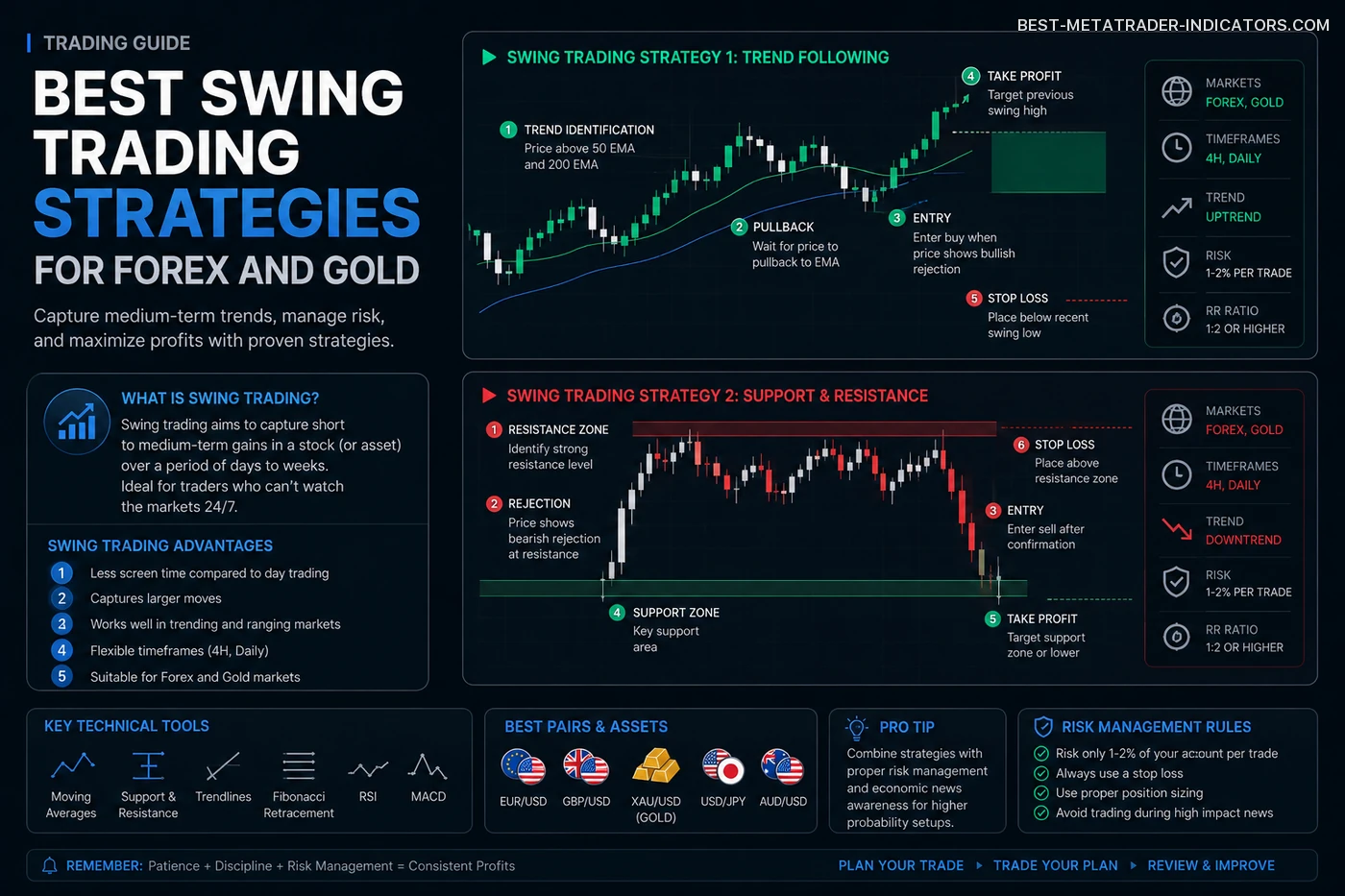
The trend pullback strategy is one of the most reliable methods for Forex and Gold. The idea is simple: find a strong trend, wait for the market to pull back into a value zone, then enter when price confirms that the trend is resuming.
How to identify the setup
- Use the daily chart to define the main direction.
- Look for higher highs and higher lows in an uptrend, or lower highs and lower lows in a downtrend.
- Use the 20 EMA and 50 EMA as dynamic trend filters.
- Wait for price to pull back toward a moving average, trendline, or previous support/resistance zone.
- Enter only after a bullish or bearish confirmation candle appears.
Best markets for this strategy: EUR/USD, GBP/USD, USD/JPY, AUD/USD, USD/CAD, and XAU/USD when they are trending cleanly on the daily chart.
Example trade idea
If XAU/USD is trading above the 50 EMA and making higher highs, wait for a pullback toward the 20 or 50 EMA. If price rejects that area with a strong bullish candle, the swing trader can consider a long position. The stop-loss can be placed below the recent swing low, while the take-profit can target the previous high or a measured extension.
🥇 Strategy 2: Gold Breakout and Retest Strategy
Gold is famous for explosive breakouts, but many traders lose money by chasing the first candle. A more professional approach is to wait for the breakout and then trade the retest. This reduces emotional entries and improves trade location.
Bullish Breakout Setup
- Gold breaks above a major resistance level.
- The breakout candle closes clearly above the zone.
- Price returns to retest the old resistance as new support.
- A bullish rejection candle confirms buyers are defending the level.
Bearish Breakdown Setup
- Gold breaks below a major support level.
- The candle closes below the zone, not just through it.
- Price retests the broken support as resistance.
- A bearish rejection candle confirms sellers are active.
This strategy works best when the breakout is supported by strong volume, clean candle closes, expanding momentum, and a clear imbalance between buyers and sellers. Avoid trading breakouts during thin liquidity or directly before sudden volatility unless your plan specifically accounts for wider spreads and slippage.
💱 Strategy 3: Forex Range Swing Trading
Not every market trends. In fact, many Forex pairs spend long periods inside ranges. Range trading can be highly profitable when done with patience, but it requires discipline. The trader buys near support, sells near resistance, and avoids entries in the middle of the range.
Range trading rules
- Identify a clear horizontal support and resistance zone on the 4-hour or daily chart.
- Wait for price to approach one side of the range.
- Look for rejection candles, false breaks, RSI divergence, or momentum exhaustion.
- Place the stop outside the range, not inside normal market noise.
- Take profits before the opposite boundary, not exactly at the maximum level.
Important warning: Range trading becomes dangerous when the market starts building pressure near one side of the range. Multiple tests of the same level can weaken it. When compression appears, prepare for a breakout instead of blindly fading the move.
⚡ Strategy 4: Volatility-Aware Swing Trading
In 2026, sharp volatility can create strong multi-day moves. Swing traders do not need to chase the first impulse candle. Instead, they can wait for the market to absorb the move, print structure, and then trade the direction that price action continues to defend.
| Market Condition | Forex Behavior | Gold Behavior | Swing Trading Approach |
|---|---|---|---|
| Major level breakout | Can shift pair structure quickly | Can trigger a fast expansion candle | Wait for a clear candle close |
| Volatility expansion | Can widen ranges and accelerate trends | Can stretch price away from fair value | Trade the second reaction, not the first spike |
| Liquidity sweep | Often clears obvious highs or lows | Often creates deep wicks in XAU/USD | Reduce size or wait for structure |
| Range compression | Can prepare the next breakout attempt | Often leads to a sharp release from the range | Use logical stops and smaller size |
🔄 Strategy 5: False Breakout Reversal Strategy
False breakouts are common in Forex and Gold because large players often need liquidity. Retail traders place stops above resistance or below support. When price briefly breaks those levels and quickly returns inside the range, it can create a powerful reversal setup.
What to look for
- Price breaks a clear high or low but fails to close beyond it.
- The candle leaves a long wick outside the zone.
- The next candle closes back inside the previous structure.
- Momentum indicators show divergence or exhaustion.
- The trade target is the opposite side of the range or the next support/resistance zone.
Trader’s note: False breakout trades work best at obvious levels. If the level is not visible to most traders, there may not be enough trapped liquidity to create a strong reversal.
🧠 Strategy 6: Multi-Timeframe Confluence
One of the biggest mistakes beginner swing traders make is taking a trade based on only one chart. A professional trader uses multiple timeframes to build confluence. The weekly chart gives the big picture, the daily chart gives the swing structure, and the 4-hour chart helps refine the entry.
Multi-timeframe analysis helps traders avoid low-quality entries and align trades with the broader market context.
| Timeframe | Purpose | What to Check | Best Use |
|---|---|---|---|
| WeeklyBig picture | Defines the higher-timeframe trend and major zones | Long-term support, resistance, trend direction | Bias filter |
| DailySwing structure | Identifies setups and market phase | Trend, pullbacks, breakouts, reversals | Main decision chart |
| 4-HourEntry refinement | Improves timing and risk placement | Candle confirmation, retests, lower timeframe structure | Execution chart |
| 1-HourOptional precision | Can help fine-tune entries | Momentum shifts, micro structure | Advanced traders only |
🛡️ Risk Management for Forex and Gold Swing Traders
No strategy can survive poor risk management. Gold can move hundreds of points quickly, and Forex pairs can gap or spike during thin liquidity or sudden volatility. The goal is not to avoid losses completely. The goal is to keep losses small enough that one bad trade, one bad day, or one bad week does not damage your trading account.
Position Sizing
Risk a fixed percentage of your account per trade. Many swing traders use 0.5% to 2% depending on experience, volatility, and account size. Gold often requires smaller position size because of its volatility.
Stop-Loss Placement
Place stops where the trade idea is invalid, not where the loss feels comfortable. A stop that is too tight can be hit by normal volatility before the move develops.
Reward-to-Risk
Aim for trades where the potential reward is at least 1.5 to 2 times the risk. The higher the win rate, the more flexible this can be, but poor reward-to-risk makes long-term consistency difficult.
Correlation Control
Do not open several trades that all depend on the same idea. For example, being long EUR/USD, long GBP/USD, and short USD/CHF may simply mean you are overexposed to one directional idea.
✅ Swing Trading Checklist Before Entering a Trade
Use this checklist before every Forex or Gold swing trade. A checklist removes emotional decisions and forces you to think like a professional.
- Is the market trending, ranging, breaking out, or reversing?
- Does the daily chart support the trade direction?
- Is the entry near a high-quality support, resistance, supply, demand, or moving-average zone?
- Is there confirmation from price action?
- Is the stop-loss placed beyond a logical invalidation point?
- Is the reward-to-risk ratio attractive?
- Are there sudden volatility events before or during the planned trade?
- Is the position size adjusted for volatility?
- Are you already exposed to the same currency, metal, or directional theme?
- Can you accept the loss emotionally and financially?
📊 Best Indicators for Swing Trading in 2026
Indicators are tools, not magic signals. The best traders use them to support price action, not replace it. In Forex and Gold, simple indicators often work better than crowded charts.
| Indicator | Best Use | How to Apply | Common Mistake |
|---|---|---|---|
| 20 EMA | Short-term trend momentum | Use as dynamic support/resistance | Buying every touch without confirmation |
| 50 EMA | Medium-term trend filter | Trade in the direction of price relative to the EMA | Ignoring market structure |
| RSI | Momentum and divergence | Look for divergence at key levels | Selling only because RSI is overbought |
| ATR | Volatility measurement | Adjust stops and targets to current volatility | Using the same stop size in all markets |
| Fibonacci | Pullback zones | Watch 38.2%, 50%, and 61.8% retracements | Treating levels as exact turning points |
🏆 Forex vs Gold: Which Is Better for Swing Trading?
Both Forex and Gold offer excellent swing trading opportunities, but they behave differently. Forex pairs can be smoother when the trend structure is clean. Gold can move faster and further, but it can also punish traders who use tight stops or oversized positions.
A practical comparison for traders choosing between major currency pairs and XAU/USD.
| Category | Forex Majors | Gold / XAU/USD | Trader Rating |
|---|---|---|---|
| VolatilityDaily movement potential | Moderate to high | High to very high | |
| LiquidityExecution quality | Excellent in major pairs | Excellent, but spreads can widen during fast moves | |
| Risk LevelAccount pressure | Manageable with good sizing | Higher due to sharp moves | |
| Best StrategyTypical edge | Trend pullbacks, ranges, structure-based trends | Breakout retests, trend pullbacks, false breaks | |
| Beginner FriendlyLearning curve | Better for beginners | Better for experienced traders |
💡 Practical Swing Trading Tips for 2026
Trade Less, But Better
The best swing traders do not need many trades. Two or three high-quality setups per week can be enough if risk is controlled and execution is consistent.
Respect the Daily Close
Daily candle closes are more meaningful than intraday spikes. A level is not truly broken until the market closes beyond it with conviction.
Avoid Emotional Scaling
Adding to losing trades without a plan is one of the fastest ways to destroy an account. Scale only when the original trade is working and your plan allows it.
Journal Every Trade
Record the setup, entry reason, stop, target, emotion, result, and lesson. Your journal is your personal trading coach.
Use Alerts
Set alerts at key levels instead of watching charts all day. This reduces overtrading and helps you wait for your planned setup.
Know When Not to Trade
No position is also a position. Stay out when spreads are wide, volatility is disorderly, or price is stuck in the middle of a messy range.
🧩 A Simple Weekly Trading Routine
Consistency is built through routine. A professional swing trader prepares before the market moves, not after emotions are already involved.
| Day | Task | Goal |
|---|---|---|
| Weekend | Review weekly and daily charts | Build the watchlist |
| Monday | Observe market tone | Avoid forcing early trades |
| Tuesday-Wednesday | Look for confirmed setups | Execute best opportunities |
| Thursday | Manage open positions | Protect profits and reduce risk |
| Friday | Decide whether to hold over the weekend | Avoid unnecessary gap risk |
❌ Common Mistakes to Avoid
- Entering trades in the middle of a range with no clear edge.
- Using the same lot size for EUR/USD and Gold without adjusting for volatility.
- Ignoring spread conditions and volatility before opening a swing position.
- Moving stop-losses further away because you do not want to accept a loss.
- Taking profits too early while letting losses run too long.
- Trading too many correlated pairs at the same time.
- Chasing breakouts after the move has already extended.
- Changing strategy after every losing trade instead of reviewing execution quality.
📚 Example Swing Trading Plan
Here is a simple model plan that can be adapted to your own style. It is not financial advice, but it shows how a professional structure can look.
Model Plan
- Markets: EUR/USD, GBP/USD, USD/JPY, AUD/USD, USD/CAD, XAU/USD.
- Timeframes: Weekly for bias, daily for setup, 4-hour for entry.
- Risk per trade: 0.5% to 1% for Gold, 1% for Forex majors.
- Minimum reward-to-risk: 1.5:1, preferably 2:1 or better.
- Allowed setups: Trend pullback, breakout retest, range reversal, false breakout.
- Volatility rule: No new trade directly into disorderly candles, wide spreads, or unclear execution conditions.
- Management rule: Move stop only for technical reasons, never because of fear.
❓ FAQs About Forex and Gold Swing Trading in 2026
Is swing trading better than day trading?
For many traders, yes. Swing trading requires fewer decisions, less screen time, and allows traders to focus on higher timeframe structure. However, it still requires discipline and risk control.
Is Gold good for swing trading?
Gold can be excellent for swing trading because it trends strongly and respects strong technical themes. However, it is volatile, so position sizing and stop placement are extremely important.
Which timeframe is best for swing trading?
The daily chart is usually the best main timeframe. The weekly chart helps define the bigger bias, while the 4-hour chart can improve entries.
How many trades should a swing trader take?
Quality matters more than quantity. Many successful swing traders take only a few trades per week and focus on clean setups with strong reward-to-risk potential.
Should I hold Forex or Gold trades over the weekend?
Only if the trade has enough profit cushion, the setup remains valid, and you accept gap risk. If uncertainty is high, reducing or closing exposure before the weekend can be wise.
Can beginners trade XAU/USD?
Beginners can trade Gold, but they should use smaller size, wider logical stops, and demo testing first. Gold moves faster than most major currency pairs.
🏁 Final Thoughts
The best swing trading strategies for Forex and Gold in 2026 are not complicated. They are built on market structure, patience, confirmation, and strict risk management. Trend pullbacks, breakout retests, range trades, false breakouts, and multi-timeframe confluence can all work when used in the right market environment.
The real edge comes from selectivity. Wait for clean levels. Respect volatility and execution conditions. Size positions correctly. Accept losses quickly. Let winning trades develop. In the long run, disciplined execution matters more than any single indicator or prediction.
Disclaimer: This article is for educational purposes only and does not constitute financial advice. Forex and Gold trading involve substantial risk and may not be suitable for every investor.