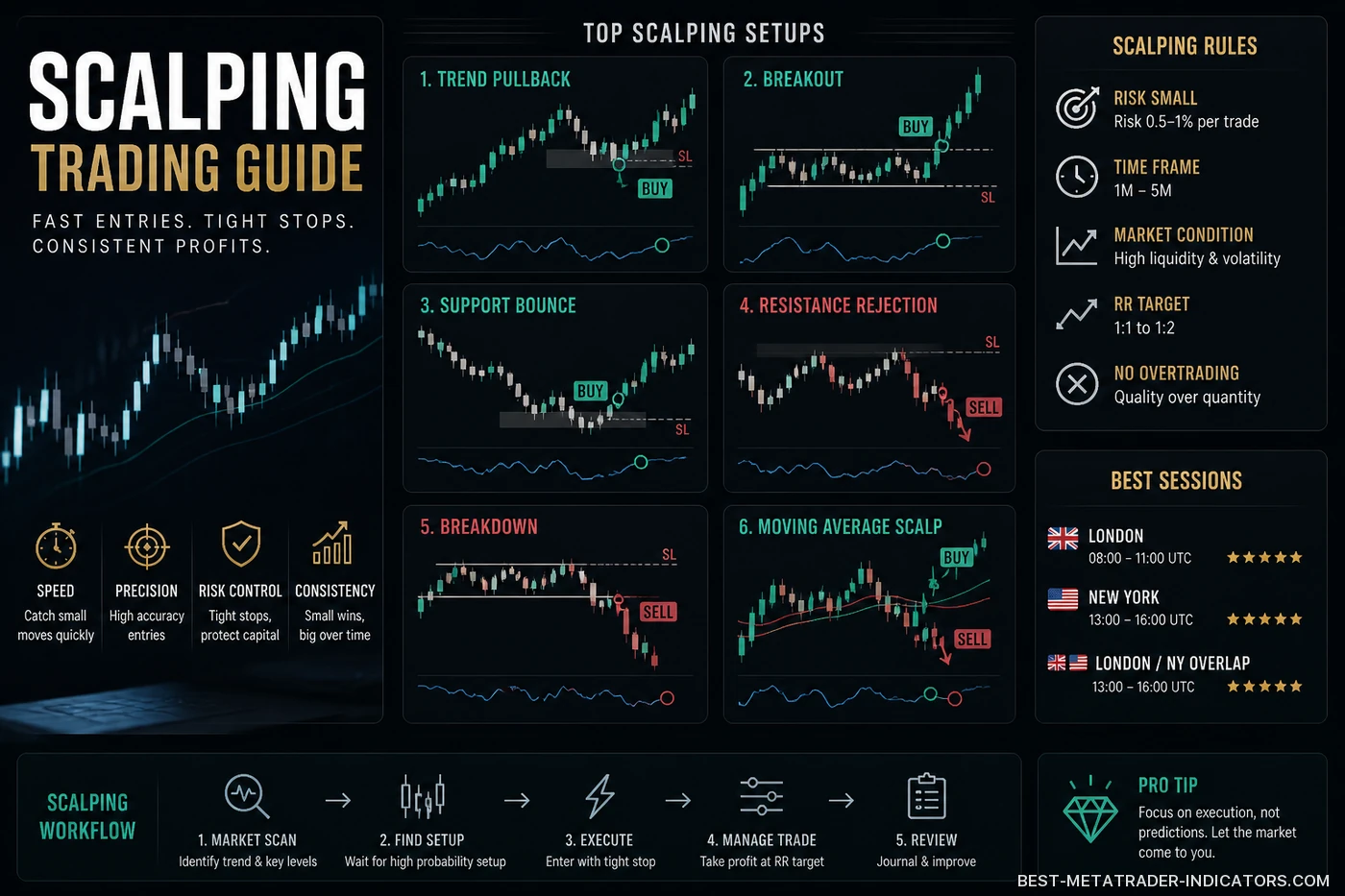
Forex scalping is one of the most intense trading styles in the currency market. A scalper does not try to predict a distant price path or build a broad market story. The scalper focuses on the next short-term imbalance: a burst of momentum, a liquidity sweep, a failed breakout, a retest, or a fast reaction around a key price level.
That sounds simple. In practice, it is anything but simple. Scalping compresses the entire trading process into a few seconds or minutes: analysis, execution, risk control, emotional discipline and exit management. Small mistakes become visible very quickly.
After more than twenty years of observing Forex markets, one lesson stands above the rest: professional scalping is not about trading more; it is about trading cleaner. The trader who waits for quality conditions usually survives longer than the trader who needs action every minute.
🎯 What Is Forex Scalping?
Forex scalping is a short-term trading method where positions are opened and closed quickly, often within seconds to a few minutes. The objective is to capture small price movements repeatedly while keeping risk tightly controlled.
Unlike swing trading, where a trader may hold a position for days, scalping focuses on intraday micro-movements. A scalper may target a few pips, a short momentum burst, a quick pullback, or a reaction from a support or resistance zone.
Simple explanation: Scalping is like entering a busy street, crossing only when the traffic gap is clear, and stepping out quickly. You are not trying to predict the entire traffic system. You are trying to make one precise decision at the right moment.
Technical explanation: Scalping attempts to exploit short-term inefficiencies in price movement, liquidity, spread behavior, order flow and intraday volatility. Because targets are small, execution costs such as spread, commission and slippage have a much larger impact than in longer-term trading.
🏛️ A Short Technical History of Scalping in Forex
Scalping existed long before modern retail trading platforms. In earlier decades, short-term currency trading was mostly handled by professional desks that focused on spread, liquidity, execution speed and immediate price response. The working logic was already technical: read the flow, control the risk and get out before the edge disappears.
In the 1990s and early 2000s, electronic trading changed the workflow. Retail platforms gave private traders live charts, instant order tickets, one-click trading and basic technical indicators. Later, tighter spreads, faster connections, ECN-style execution and MetaTrader-compatible tools made short-term chart trading more accessible.
Today, scalping has entered a more structured phase. Traders use VPS hosting, MetaTrader expert advisors, custom indicators, spread monitors, order-flow tools, position-size scripts and trade analytics. But the core has not changed: the market still rewards discipline and punishes poor execution.
Important correction: Scalping is not automatically easier because technology is better. Faster platforms can help, but they also make it easier to overtrade, revenge trade and increase position size too quickly.
🌍 Why Forex Charts Still Attract Scalpers
Forex charts remain attractive for scalpers because major pairs often show deep liquidity, long trading hours and frequent short-term movement. That does not make scalping easy, but it gives technical traders enough recurring structure to study breakouts, pullbacks, failed breaks and range reactions session after session.
Major pairs such as EUR/USD, GBP/USD, USD/JPY and USD/CHF often provide tighter spreads than exotic pairs. For scalpers, this matters. A trader targeting five pips cannot ignore a two-pip spread, commission, slippage or slow execution.
Liquidity
Major currency pairs usually provide better liquidity and tighter pricing than many smaller markets.
Session Choice
London, New York and the overlap between both sessions often offer more movement and cleaner opportunities.
Short-Term Volatility
Scalpers need movement, but they also need movement that is tradable rather than chaotic.
🧠 The Scalper’s Mindset
The scalper’s mindset is different from the investor’s mindset. A long-term investor asks, “Where could this asset be in five years?” A scalper asks, “Is there enough short-term imbalance right now to justify a controlled trade?”
This difference matters because scalping is not a search for certainty. It is a search for repeatable conditions. The trader does not need to win every trade. The trader needs a process where the average winner, average loser, win rate and execution costs make sense together.
Mental model: Think of scalping as professional decision-making under time pressure. Your edge is not one magic indicator. Your edge is the combination of context, timing, cost control, position sizing and emotional stability.
🔍 So You Recognize It in Practice
Many beginners understand scalping in theory but struggle to recognize a real setup on the chart. A practical scalping opportunity often has several ingredients at the same time: a clear level, active session, visible reaction, acceptable spread, defined risk and enough room to the target.
| What You See | What It May Mean | Scalper’s Question |
|---|---|---|
| Price rejects a level quickly | Liquidity may have been swept and absorbed. | Is there confirmation before entry? |
| Spread suddenly widens | Liquidity may be thin or execution conditions may be deteriorating. | Should I avoid the trade? |
| Breakout fails immediately | Trapped traders may fuel a reversal. | Where is the clean invalidation level? |
| Trend pulls back to VWAP or EMA | Momentum traders may defend the trend. | Is the pullback controlled or aggressive? |
| Price stalls before your target | Momentum may be fading. | Should I reduce, exit or tighten risk? |
📊 Best Market Conditions for Scalping
Scalping works best when the market is liquid enough for tight execution and active enough to move. It performs poorly when spreads are wide, volatility is dead, or price is moving randomly without structure.
Scalping Conditions Compared
Not every active market is a good scalping market. The quality of movement matters more than noise.
| Condition | Quality | Typical Action | Risk Note |
|---|---|---|---|
| London OpenHigh liquidity | Breakout, pullback or momentum scalp. | Watch for fake first moves. | |
| London/New York OverlapStrong participation | Trend continuation or reversal from major levels. | Volatility can expand quickly around crowded technical levels. | |
| Asian SessionOften calmer | Range scalping on selected pairs. | Targets should usually be smaller. | |
| Fast Volatility SpikeHigh volatility | Usually wait until spreads normalize and candles regain structure. | Slippage can destroy a good-looking setup. | |
| Holiday MarketThin liquidity | Often best to reduce activity. | False moves and poor fills are common. |
🧩 Core Scalping Strategies
No single scalping strategy works in every environment. A professional trader matches the strategy to the market condition. A breakout method may work well in a strong session, while a range method may work better during quieter hours.
Breakout Scalping
This strategy looks for price to break above resistance or below support with strong momentum. The goal is to join the first impulse or the first retest after the break.
- Best during active sessions.
- Works better with clear pre-breakout compression.
- Requires fast invalidation if the breakout fails.
Pullback Scalping
The trader identifies a short-term trend and waits for price to pull back into a dynamic area such as an EMA, VWAP or former breakout level.
- Best in clean trending conditions.
- Requires patience because chasing late entries increases risk.
- Works best when the pullback is controlled, not violent.
Range Scalping
Price moves between a short-term support and resistance zone. The scalper buys near the lower boundary and sells near the upper boundary, only when confirmation appears.
- Best during calmer sessions.
- Needs smaller targets and strict exits.
- Dangerous when a real breakout begins.
Volatility Reaction Scalping
This method does not blindly enter into the first spike. Instead, the trader waits for the initial emotional move, then looks for continuation or reversal only after spreads, candles and market structure stabilize.
- Only suitable for experienced traders.
- Requires experience reading spread behavior and fast candle rejection.
- Slippage risk must be taken seriously.
🧪 Mini Case Study: The Failed Breakout Trap
Imagine EUR/USD has been trading below 1.0850 for one hour. During the London session, price breaks above 1.0850 and attracts breakout buyers. But instead of continuing, the candle quickly returns below the level. The breakout buyers are now trapped.
A patient scalper does not sell randomly. The trader waits for a retest of 1.0850 from below, checks whether buyers fail to reclaim the level, and then enters short with a tight stop above the rejection zone. The target may be the previous intraday midpoint or liquidity below the range.
What this example teaches: The setup is not “price went up, so sell.” The setup is: breakout, failure, retest, rejection, defined risk and a logical target. That sequence creates structure.
📌 Practical Tips for Better Scalping
Scalping rewards preparation. A trader who opens the platform without a plan is already late. Before the session begins, know your pairs, levels, volatility events, maximum risk and trade limit.
Mark Levels First
Identify intraday highs, lows, session opens, round numbers and previous reaction zones before trading.
Respect Costs
Spread, commission and slippage are not small details. In scalping, they are part of the strategy.
Use a Trade Limit
Set a maximum number of trades per session. More trades often mean lower selectivity.
Exit Fast When Wrong
Scalping losses should usually be small and accepted quickly. Hope is not an exit strategy.
Journal Every Session
Record screenshots, entry reason, exit reason, emotional state and execution quality.
Avoid Dead Time
Flat, illiquid markets can tempt traders into poor setups. Sometimes the best scalp is no scalp.
✅ Scalping Checklist Before Entering a Trade
A checklist slows the emotional brain and protects the trader from impulsive entries. It does not guarantee success, but it improves consistency.
| Question | Why It Matters |
|---|---|
| Is the spread acceptable? | A wide spread can make a small target unrealistic. |
| Is there a clear level? | Random entries are difficult to manage objectively. |
| Is my stop-loss logical? | The stop should be based on invalidation, not fear. |
| Is there enough room to target? | Do not enter directly into the next obstacle. |
| Is volatility likely to disrupt execution? | Sudden volatility can create slippage and spread expansion. |
| Am I calm? | Emotional trading turns scalping into gambling. |
📈 New Technical Trends in Forex Scalping
Scalping is changing. The old image of a trader staring at one chart and manually clicking every move is outdated. Modern scalpers increasingly combine discretionary price-action skill with MetaTrader tools, automation, alerts and better risk dashboards.
Indicator-Assisted Preparation
MetaTrader-compatible indicators are often used to structure preparation: session separators, ATR bands, VWAP-style tools, spread panels and multi-timeframe moving averages. They can help with context, but they should not replace risk control or independent chart reading.
Smarter Trading Journals
Modern journals can automatically track screenshots, sessions, symbols, win rates, average holding time and mistakes. For scalpers, this data is valuable because small inefficiencies repeat often.
Rule-Based Execution Tests
Many short-term traders now test strategies under strict rule sets with daily drawdown limits, maximum loss limits and consistency targets. This can be useful for discipline, but the trader must know exactly how the strategy behaves under those limits.
Mobile Risk Monitoring
Mobile platforms are better than before, but serious scalping still benefits from a stable desktop setup, fast connection and clean chart layout. Mobile is useful for monitoring, not always ideal for precision entries.
Hybrid Manual + Algorithmic Workflows
Some traders use scripts for alerts, position sizing or partial exits while keeping final decision-making manual. This can reduce mistakes without turning the strategy into a black box.
Greater Focus on Regulation
Retail traders are paying more attention to broker regulation, client money protection, transparent fees and execution quality. Scalpers should care about these details more than most traders.
🛠️ MetaTrader Tools Scalpers Are Watching
The best tool is not always the most complicated one. For scalping, the right tool is the one that improves execution, reduces mistakes or gives clearer feedback after the session.
| Tool / Product Type | Useful For | Professional Warning |
|---|---|---|
| Low-spread ECN-style accounts | Reducing transaction costs on frequent trades. | Check commission, slippage and real execution, not only advertised spreads. |
| VPS hosting | Improving platform stability for automated tools and fast execution. | Useful, but not a substitute for a profitable strategy. |
| Spread and volatility alerts | Avoiding entries when spreads expand or candle ranges become unstable. | Do not ignore platform conditions when the chart starts moving faster than your process. |
| Trade analytics dashboards | Finding repeated mistakes and performance patterns. | Data helps only if the trader is honest with the journal. |
| MetaTrader scripts and utilities | Automating position size, partial exits, break-even moves and screenshot routines. | Never let scripts override the original trading plan without validation. |
| Depth-of-market tools | Reading liquidity behavior on supported platforms. | Spot FX is decentralized, so displayed depth may not represent the entire market. |
⚖️ Advantages and Disadvantages of Scalping
A professional article about scalping should not sell a fantasy. Scalping has real advantages, but also serious drawbacks. The right question is not “Is scalping good or bad?” The right question is: Does scalping fit your personality, capital, broker conditions and daily schedule?
Advantages
- Many potential opportunities during active sessions.
- Short exposure time compared with overnight trades.
- Fast feedback on execution and decision quality.
- Clear focus on process, risk and precision.
- Can be combined with strict daily loss limits.
Disadvantages
- High mental pressure and decision fatigue.
- Transaction costs have a strong impact.
- Requires reliable execution and stable internet.
- Easy to overtrade when bored or frustrated.
- Not ideal for traders who cannot watch the market closely.
🆚 Scalping Compared With Other Trading Styles
Scalping is only one way to trade Forex. Many traders fail because they choose a style that does not match their personality. A patient person may be better suited to swing trading. A highly focused person with fast execution skills may prefer scalping.
Trading Style Comparison
Choose your trading style based on temperament, time availability and risk tolerance — not social media hype.
| Style | Holding Time | Main Skill | Best For | Main Risk |
|---|---|---|---|---|
| ScalpingVery short-term | Seconds to minutes | Execution and discipline | Focused active traders | Overtrading and costs |
| Day TradingIntraday | Minutes to hours | Session structure | Traders who want no overnight risk | Chasing intraday noise |
| Swing TradingShort to medium-term | Days to weeks | Patience and trend reading | Busy traders | Gaps, wide stops and slow invalidation |
| Position TradingLong-term | Weeks to months | Higher-timeframe structure | Strategic traders | Large drawdowns and patience pressure |
🧭 What Professional Scalpers Watch
Professional scalpers do not only look at indicators. They pay attention to liquidity zones, volatility, session behavior, spread behavior, candle quality and execution. The chart setup must be tradable in real conditions, not just attractive in hindsight.
Liquidity Zones
Professionals care where orders may be clustered: previous highs, lows, round numbers, failed breakout levels and obvious stop areas.
Spread Risk
Sudden spread expansion can turn a precise scalp into a poor trade before the entry is even filled.
Volatility Regime
A strategy that works in a calm market may fail in a high-volatility regime. Scalpers must adapt targets and stops.
Execution Quality
Fill speed, slippage, rejection rates and spread behavior matter. A beautiful chart setup is useless if execution is poor.
🎛️ Key Technical Influencing Factors
Several factors influence whether a scalping setup is attractive or dangerous. Beginners often focus only on the entry signal. Experienced traders look at the environment around the signal.
- Spread: The smaller the target, the more important the spread becomes.
- Volatility: Too little movement reduces opportunity; too much chaos increases slippage.
- Session: London and New York often behave differently from late Asian trading.
- Volatility timing: Fast volatility can invalidate technical setups before risk can be reduced.
- Broker model: Execution quality and trading rules vary between providers.
- Trader condition: Fatigue, stress and frustration damage scalping performance quickly.
📏 Typical Ranges and Orientation Values
Every trader must test their own strategy, but beginners often need orientation. The following ranges are not rules. They are practical reference points for thinking about scalping more realistically.
| Element | Typical Scalping Range | Comment |
|---|---|---|
| Holding time | Seconds to 15 minutes | Some trades last longer, but then they become closer to day trades. |
| Target size | 3 to 15 pips on major pairs | Depends heavily on volatility and pair behavior. |
| Risk per trade | Often below 1% | Many professionals risk much less per scalp because trade frequency is higher. |
| Daily trade count | 3 to 15 quality trades | More is not automatically better. Quality matters. |
| Daily stop limit | Predefined before trading | Essential for avoiding revenge trading. |
🔄 What Happens If…?
Good scalpers think in scenarios. They do not enter and hope. They ask what happens if the market behaves differently from the plan.
What happens if spread widens?
Your trade may start at an immediate disadvantage. A setup that looked profitable can become unattractive before entry.
What happens if price misses your entry?
Professional answer: let it go. Chasing usually turns a planned trade into an emotional trade.
What happens if you take three losses in a row?
Stop and review. Three losses may be normal, but emotional escalation after them is dangerous.
What happens if volatility expands suddenly?
Reduce risk quickly. During violent price shocks, technical levels can fail and execution can deteriorate.
🚫 Common Mistakes in Scalping
Most scalping mistakes are not complicated. They are repeated because the trader wants action, certainty or quick recovery after a loss.
- Trading without a session plan: Entering randomly because the chart is moving.
- Ignoring spread and commission: A strategy can look good before costs and fail after costs.
- Moving the stop-loss: A small planned loss becomes a large emotional loss.
- Trading during violent volatility without experience: Slippage can be much worse than the chart suggests.
- Chasing missed moves: Late entries often have poor reward-to-risk.
- Increasing lot size after losses: This is not professional risk management; it is revenge trading.
- Using too many indicators: More signals can create more confusion, not more clarity.
- Stopping the journal: Without review, the same mistakes remain invisible.
🧨 Myths and Misunderstandings
Scalping is surrounded by myths. Some make it sound too easy. Others make it sound impossible. The truth is more balanced.
| Myth | Reality |
|---|---|
| Scalping means trading all day. | Professional scalpers often focus on selected sessions and stop when conditions decline. |
| More trades mean more profit. | More trades often mean more costs, more mistakes and lower selectivity. |
| A high win rate is enough. | A high win rate can still lose money if losses are too large or costs are too high. |
| A custom indicator can scalp for you automatically. | Indicators can help with structure, but untested automation can fail quickly in live markets. |
| Scalping is always bad for beginners. | Beginners can study scalping, but live scalping with real money requires caution, small size and strong discipline. |
🧱 Where Scalping Does Not Work Well
Scalping is not a universal solution. It becomes weak when market structure is unclear, execution is poor, or the trader is not mentally prepared.
Counterexample: A trader sees a one-minute candle moving fast during a thin holiday session and enters aggressively. The spread is wider than usual, liquidity is poor and price snaps back. The trader did not lose because scalping is impossible. The trader lost because the environment was bad for scalping.
🧠 Why Scalping Is Often Misunderstood
Scalping is often misunderstood because social media shows the exciting part: fast entries, quick profits and dramatic screenshots. It rarely shows the boring but important part: waiting, journaling, reducing size, stopping after a loss limit and skipping poor conditions.
Another misunderstanding is that scalping must be hyperactive. In reality, the best scalpers can be surprisingly patient. They may watch ten moves and trade only one. Their confidence comes from selectivity, not from constant action.
🧭 Decision Help: Is Scalping Right for You?
Scalping can be attractive, but it is not suitable for everyone. Use the following questions honestly.
| Question | If Yes | If No |
|---|---|---|
| Can you focus without distraction? | Scalping may fit your working style. | Day trading or swing trading may be better. |
| Can you accept small losses quickly? | You have an important scalping trait. | Practice on demo before risking real money. |
| Do you have low trading costs? | Your strategy has a better chance after costs. | Costs may destroy the edge. |
| Do you journal consistently? | You can improve based on evidence. | You may repeat the same mistakes. |
| Do you have a fixed daily stop? | You reduce the risk of emotional damage. | Scalping can become dangerous very quickly. |
💡 Professional Recommendations
Here are practical recommendations that can make scalping more professional and less emotional.
- Start with one or two major pairs. Learn their rhythm before adding more markets.
- Define your trading window. A focused 90-minute session is often better than staring at charts all day.
- Use a maximum daily loss. When it is reached, stop trading. No negotiation.
- Track execution quality. Record whether you entered according to plan, not only whether the trade won.
- Separate analysis from execution. Prepare levels before the session so you are not improvising under pressure.
- Do not copy lot sizes from others. Your account, risk tolerance and strategy statistics are unique.
- Review losing trades calmly. A losing trade can still be a good trade if it followed the plan.
📚 Example Scalping Routine
A routine makes scalping less random. The following example can be adapted to different trading styles.
Before the Session
- Check session volatility and spread behavior.
- Mark major levels.
- Check spreads and platform stability.
- Define maximum loss and maximum trades.
During the Session
- Wait for price to reach planned areas.
- Enter only when risk is clear.
- Accept invalidation quickly.
- Avoid chasing missed moves.
After the Session
- Save chart screenshots.
- Review mistakes and best decisions.
- Calculate net result after costs.
- Write one improvement point for tomorrow.
Stop Conditions
- Daily loss limit reached.
- Three emotional trades in a row.
- Spreads become abnormal.
- Focus drops below professional level.
❓ Forex Scalping FAQs
Is Forex scalping profitable?
It can be profitable for skilled traders with a tested strategy, low costs and strong discipline. It is not automatically profitable and it is not easy money.
How long does a scalping trade last?
Many scalping trades last from seconds to a few minutes. If the holding time becomes much longer, the trade may be closer to day trading.
Which pairs are best for scalping?
Major pairs such as EUR/USD, GBP/USD and USD/JPY are popular because they often have higher liquidity and tighter spreads than exotic pairs.
Can indicators replace a scalper?
Indicators can support structure, journaling and pattern recognition, but relying blindly on signals is risky. Live execution and risk management still matter.
Should beginners scalp?
Beginners should first practice on demo, learn risk management and understand trading costs. Scalping with real money too early can be expensive.
How much capital is needed?
There is no universal number. What matters is using position size responsibly, avoiding overleverage and trading only money you can afford to risk.
Should scalpers trade volatility spikes?
Most beginners should avoid trading directly into violent spikes. Spreads, slippage and candle ranges can change too quickly.
What is the most important scalping metric?
Net profitability after spread, commission and slippage is more important than win rate alone. A high win rate can still lose money if losses are too large.
🏁 Final Thoughts
Forex scalping is fast, demanding and often misunderstood. It is not a shortcut to wealth, and it is not simply a matter of clicking faster than everyone else. The professional scalper is selective, prepared and emotionally controlled.
The best scalping approach combines four dimensions: context to know when conditions are attractive, depth to understand risks and limitations, application to execute with structure, and thinking to avoid emotional traps.
If you want to scalp Forex, focus less on finding the perfect indicator and more on building a repeatable process: clean levels, low costs, strict risk, session discipline, honest journaling and the courage to stop when the market is not offering quality.
Professional reminder: Trading involves risk. This article is for educational purposes only and does not constitute financial advice. Always test strategies carefully and make decisions based on your own situation, risk tolerance and personal rules.
Disclaimer: Trading involves risk. This article is for educational purposes only and does not constitute financial advice. Always test strategies carefully, use responsible position sizing and make decisions based on your own risk tolerance.