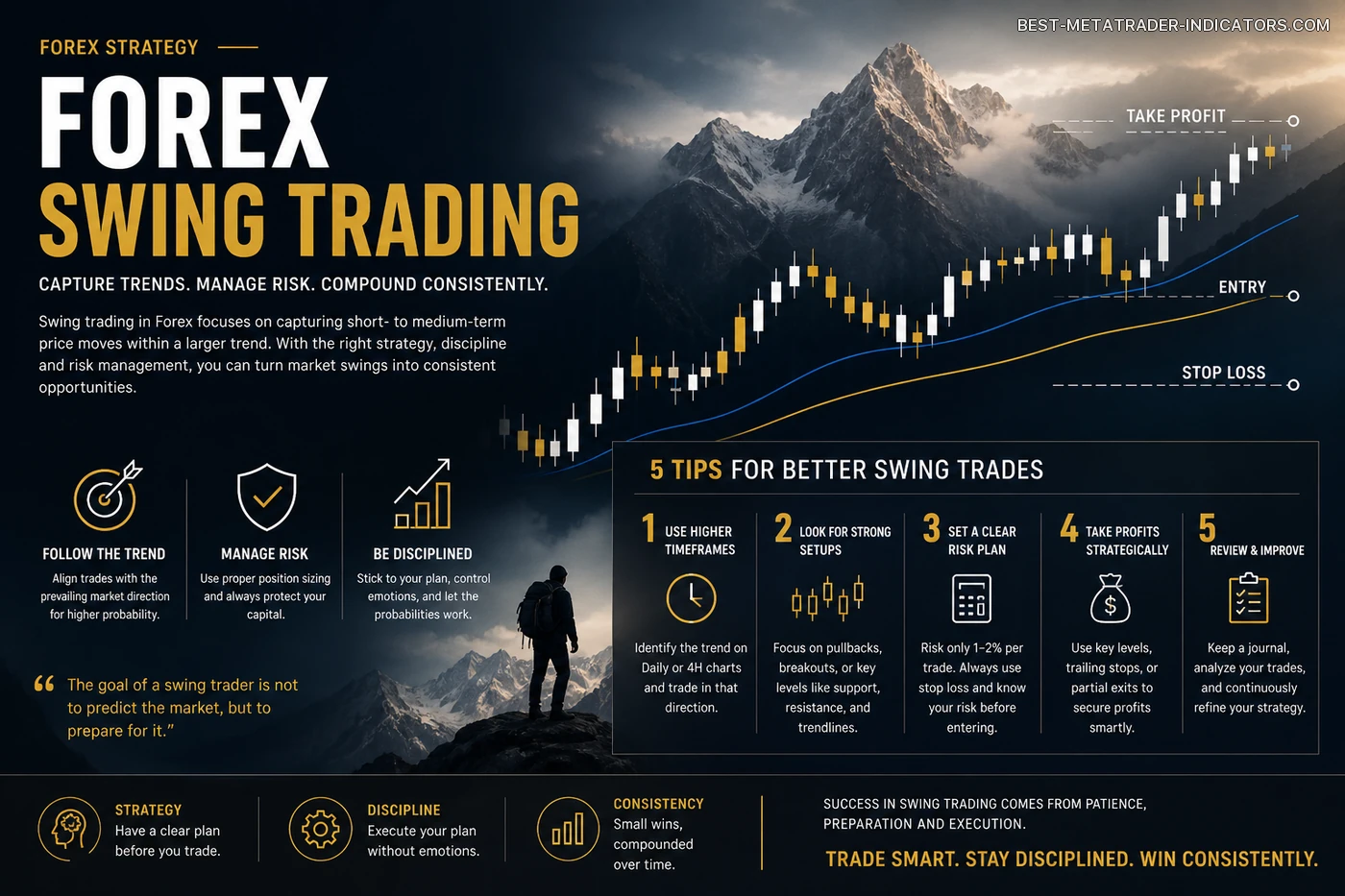
Swing trading is one of the most practical approaches in Forex trading because it sits between fast day trading and long-term position trading. Instead of chasing every small intraday fluctuation, swing traders focus on larger price movements that may develop over several days or weeks.
For many traders, this style feels realistic because it does not demand constant screen time. You do not need to trade every session, and you do not need to react to every candle. You do need a clear process, emotional discipline, and the patience to let price come into your planned area.
This guide explains swing trading from a technical, trader-focused perspective: setups, market structure, indicators, checklists, common mistakes, trading psychology, MetaTrader-compatible tools, and the way experienced traders manage Stop Loss and Take Profit decisions.
🧭 What Is Swing Trading?
Simply explained, swing trading means trying to capture a “swing” in price. A swing can be a move from support to resistance, a pullback within a trend, or a breakout that develops into a larger directional move.
👶 Beginner Definition
Swing trading means buying when the chart shows a reasonable chance of moving higher over the next few days, or selling when the chart shows a reasonable chance of moving lower. The trade is usually held longer than a day trade but shorter than a position trade.
🧠 Advanced Definition
Technically, swing trading is a structured attempt to exploit medium-term price movement created by trend continuation, liquidity shifts, volatility expansion, failed breakouts, or temporary imbalance between buyers and sellers.
Mental model: Think of the market like an ocean. Scalpers try to catch ripples. Day traders ride short waves. Swing traders wait for the bigger wave, enter with structure, and exit before the tide visibly changes.
🏛️ A Short History of Swing Trading
Swing trading did not begin with modern apps, social media charts, or online platforms. The idea is much older. Traders have always tried to profit from intermediate moves between major highs and lows, using chart structure, repeated price behavior, and end-of-day closes to identify turning points.
In earlier market environments, swing trading was often used by traders who could not watch every tick. They focused on daily closes, weekly price patterns, volume behavior, trend phases, and visible support and resistance. As Forex platforms became more accessible, the same technical logic moved naturally into currency trading.
Today, swing trading remains relevant because price still moves through the same basic phases: impulse, pullback, consolidation, breakout, rejection, and continuation. The platforms are faster, but the chart behavior and trader psychology are still familiar.
Professional insight: Good swing trading is not old-fashioned. It filters out much of the noise created by low-timeframe movement, emotional entries, and constant chart watching.
🌍 Why Swing Trading Matters in Today’s Forex Market
The Forex market has become faster, more automated, and more crowded with short-term reactions. For swing traders, that makes technical structure even more valuable. Clean levels, trend direction, volatility ranges, and invalidation points help separate tradable setups from random movement.
Modern Forex trading is also influenced by platform tools, algorithmic execution, chart scanners, alerts, MetaTrader indicators, copy trading dashboards, and advanced order management. These tools can help, but they can also create overconfidence if they are used without a written trading plan.
Important: Tools do not remove trading risk. Alerts, indicators, Expert Advisors, scripts, and signal dashboards may improve workflow, but they do not replace risk management, chart reading, or personal accountability.
🚀 New Trends and Products in Forex Swing Trading
🤖 AI-Assisted Chart Review
Many traders now use AI tools to organize trade journals, summarize chart observations, and review repeated mistakes. Used carefully, this can support preparation. Used poorly, it becomes another shortcut that replaces thinking.
📊 Smart Alerts and Automation
Modern platforms allow traders to set alerts around support, resistance, moving averages, volatility zones, trendlines, and breakout levels. This is useful for swing traders because it reduces screen time and protects patience.
🏦 Funded Trading Accounts
Funded account models are popular among retail traders, but swing traders must understand the rules around daily drawdown, trailing drawdown, consistency, maximum loss, and holding trades through wider pullbacks.
🔁 Copy Trading and Signal Platforms
Copy trading can be educational when used for observation, but it becomes dangerous when traders copy entries without understanding Stop Loss placement, leverage, holding time, drawdown, or the strategy behind the signal.
📊 Premium Indicators with Forex Signals for MT4 and MT5



📊 Swing Trading vs Day Trading vs Position Trading
Each trading style has a different rhythm. Swing trading is often attractive because it balances opportunity with lower screen pressure and more time for planned decisions.
| Trading Style | Typical Holding Time | Common Timeframes | Main Strength | Main Weakness |
|---|---|---|---|---|
| ScalpingVery short-term trading | Seconds to minutes | 1m, 3m, 5m | Many possible entries | High stress and tight execution pressure |
| Day TradingIntraday opportunities | Minutes to hours | 5m, 15m, 1H | No overnight exposure | Requires focus and regular screen time |
| Swing TradingMedium-term market swings | Days to weeks | 4H, Daily, Weekly | Good balance of timing and patience | Exposure to overnight gaps and deeper pullbacks |
| Position TradingLonger chart cycles | Weeks to months | Daily, Weekly, Monthly | Captures broader moves | Requires patience through large retracements |
🧱 The Foundation: Market Structure
Most swing trading strategies start with market structure. Before asking “Where should I enter?”, ask “What is the market actually doing?” That one question often prevents weak trades.
📈 Uptrend
Price forms higher highs and higher lows. Swing traders often look to buy pullbacks instead of chasing candles that are already extended.
📉 Downtrend
Price forms lower highs and lower lows. Traders often look for rallies into resistance where a short entry can be planned with clear invalidation.
🔁 Range
Price moves sideways between support and resistance. Swing traders may buy near the bottom and sell near the top until the range breaks with conviction.
🔍 So You Recognize It in Practice
You recognize a potential swing trading setup when:
- Price reaches a clear support or resistance zone.
- The higher timeframe shows a readable trend or range.
- The trade has enough space to move before the next major level.
- The Stop Loss can be placed at a logical invalidation point.
- The potential Take Profit is meaningfully larger than the risk.
- The trade idea still makes sense even if you cannot watch every candle.
⚙️ Core Swing Trading Strategies
📈 1. Trend Pullback Strategy
This is one of the cleanest swing trading methods. The trader identifies a strong trend, waits for a pullback, and enters only when price shows signs of continuation instead of trying to guess the exact low or high.
Example: EUR/USD is in an uptrend on the daily chart. Price pulls back into a previous breakout zone and forms a bullish rejection candle. A swing trader may enter long with a Stop Loss below the pullback low and a Take Profit near the next resistance area.
🔁 2. Breakout and Retest Strategy
Instead of buying the first breakout candle, the trader waits for price to return to the broken level. If the level holds and price rejects it cleanly, the retest may offer a calmer entry.
Why it works: The retest helps confirm whether the breakout has real follow-through or whether it was only a temporary liquidity spike that trapped late traders.
⚡ 3. Reversal Strategy
Reversal swing trades try to catch the turning point after an extended move. These setups can be powerful, but they require patience, confirmation, and a strict invalidation level.
Common signs: Failed breakout, RSI divergence, exhaustion candle, major weekly level, double top, double bottom, or a sharp rejection from a historical zone.
📦 4. Range Strategy
When price is trapped between support and resistance, swing traders can trade from one side of the range to the other. The danger is entering near the middle, where the Stop Loss is often awkward and the reward is limited.
Rule of thumb: The closer your entry is to the edge of the range, the more attractive the setup usually becomes, provided the opposite side still leaves enough room for the Take Profit.
💡 Practical Swing Trading Ideas
- Trade with the weekly bias: Use the weekly chart to understand the bigger structure, then refine entries on the daily or 4-hour chart.
- Build a watchlist: Follow a limited number of currency pairs instead of jumping randomly between charts.
- Use alerts: Let MetaTrader or your charting platform tell you when price reaches your level instead of checking charts every hour.
- Plan before the session: The best swing trading decisions are usually made before emotions are involved.
- Review closed trades: The goal is not only to make money, but to understand which setups deserve more attention and which ones should be avoided.
🧪 Mini Case Study: A Clean Breakout Retest
Scenario: GBP/USD has been stuck below a clear resistance zone for several weeks. Price finally breaks above the level and closes firmly on the daily chart.
Amateur reaction: Buy immediately because the candle looks strong and the breakout feels obvious.
Professional reaction: Wait for a retest. If the old resistance becomes support and sellers fail to push price back below the level, the setup becomes more interesting.
Lesson: Swing trading is often less about being first and more about being patient enough to enter where the Stop Loss is logical and the Take Profit has room to breathe.
🧠 How Professional Traders Use Swing Concepts
Professional traders do not usually think in terms of “perfect indicators.” They focus on liquidity areas, clean structure, volatility behavior, execution quality, and whether the chart offers a trade with defined risk.
🏦 Institutional-Style Focus
Larger traders often watch liquidity pools, previous highs and lows, stop clusters, option-related levels, and areas where many traders are likely to enter or exit. These zones can influence where larger swing moves begin or fail.
🧭 Retail Advantage
Retail traders cannot move the market, but they can be flexible. They can wait, avoid poor conditions, reduce risk quickly, and focus only on setups that are clear enough to explain before entry.
🌡️ What Influences a Forex Swing Trade?
| Influence Factor | Why It Matters | Trader’s Question |
|---|---|---|
| Market structure | Higher highs, lower lows, ranges, and breaks define the trading plan. | Is price trending, ranging, or changing character? |
| Support and resistance | Clear levels help define entry, Stop Loss, and Take Profit zones. | Where is the trade idea invalidated? |
| Volatility | Low or high volatility changes stop distance and target expectations. | Does the Stop Loss give the trade enough room? |
| Liquidity | Thin liquidity can create false breakouts, sharp spikes, and stop runs. | Is this move happening in clean trading conditions? |
| Technical indicators | Indicators can support the setup when they confirm structure rather than replace it. | Does the indicator agree with price action? |
📏 Typical Ranges and Practical Guidelines
There are no fixed rules that work for every pair or every market environment. Still, these practical ranges can help traders build realistic expectations:
- Typical holding time: 2 days to 3 weeks.
- Common risk per trade: Often 0.5% to 2% of account equity for disciplined traders.
- Common reward target: Many swing traders look for at least 1:2 risk-to-reward.
- Useful timeframes: Weekly for bias, daily for setup, 4-hour for entry refinement.
- Best conditions: Clear trend, clean range, or decisive breakout with room to move.
⚖️ Advantages and Disadvantages of Swing Trading
✅ Advantages
- Less screen time than day trading.
- More time to analyze and plan.
- Can suit traders with jobs or businesses.
- Filters out some intraday noise.
- Allows larger market moves to develop.
⚠️ Disadvantages
- Exposure to overnight and weekend gaps.
- Requires patience during pullbacks.
- Fewer setups than lower-timeframe trading.
- Technical patterns can fail suddenly.
- Trades may take days before showing results.
🧩 Good, Bad, or Neutral? The Right Context Matters
A pullback is not automatically bad. In a healthy trend, a pullback can create a better entry. A breakout is not automatically good. Some breakouts fail because they only collect liquidity before reversing. A losing trade is not automatically a mistake. Sometimes the setup was valid, but the market simply did not follow through.
Professional mindset: Do not judge a trade only by the outcome. Judge it by the quality of the decision, the risk control, and whether the trade followed your plan.
❓ What Happens If You Enter Too Early?
If you enter too early, three things usually happen. First, your Stop Loss must be wider because the market has not confirmed the setup. Second, your emotional pressure increases because the trade may move against you before your idea develops. Third, you may exit too soon, just before the real move begins.
Better approach: Let price prove itself. A slightly later entry with better confirmation is often stronger than an early entry based only on hope.
🚫 Where Swing Trading Does Not Work Well
Swing trading is powerful, but it is not suitable for every situation. It works poorly when the trader forces setups in chaotic markets, ignores volatility, trades without structure, or uses excessive leverage.
- Low-liquidity periods: Price can spike randomly and trigger stops.
- Unclear chart structure: If direction is messy, the edge is weaker.
- Messy sideways markets: If support and resistance are unclear, the trade location is usually poor.
- Overextended trends: Buying too late or selling too late often creates weak risk-to-reward.
🧾 Swing Trading Checklist
Before entering a trade, confirm:
- The higher timeframe bias is clear.
- The entry zone is technically meaningful.
- The Stop Loss has a logical invalidation point.
- The potential Take Profit is worth the risk.
- The chart has enough room before the next major level.
- The position size fits your risk plan.
- You know what would make you exit early.
- You are not entering because of boredom, revenge, or fear of missing out.
🛠️ Recommended Tools for Swing Traders
📅 MetaTrader Alerts
Use price alerts around support, resistance, trendlines, moving averages, and planned entry zones so you do not need to stare at the chart all day.
📓 Trading Journal
A journal helps identify which setups actually work for you and which mistakes repeat under pressure.
🔔 Price Alerts
Alerts help you wait for price to reach your level instead of chasing random movement or entering from impatience.
📉 Volatility Measures
Average True Range, candle range, and recent swing size can help place more realistic stops and targets.
🧮 Position Size Calculator
This keeps risk consistent across different pairs, stop sizes, and account balances.
📊 Indicator Templates
A simple MetaTrader template with moving averages, ATR, RSI, and clean support and resistance markings can keep analysis consistent without crowding the chart.
⚠️ Common Mistakes
- Trading without a higher-timeframe view: A 4-hour signal against a strong weekly structure can fail quickly.
- Using too much leverage: Swing trades need room. Overleveraged traders cannot tolerate normal pullbacks.
- Moving the Stop Loss: If your invalidation point is hit, the trade idea is no longer valid.
- Taking profits too early: Many traders cut winners fast and hold losers too long.
- Changing strategy after every loss: One losing trade does not mean the system is broken.
- Ignoring holding costs: Overnight financing can matter, especially on longer holds.
🧨 Myths and Misunderstandings
❌ Myth 1: Swing Trading Is Easy
It is slower than day trading, but not easier. The emotional challenge is different: waiting, holding, and trusting the plan.
❌ Myth 2: More Indicators Mean Better Signals
Too many indicators often create confusion. A clean chart with clear levels can be more useful than a crowded screen.
❌ Myth 3: A High Win Rate Is Everything
A trader can be profitable with a moderate win rate if average winners are larger than average losers and risk is controlled.
❌ Myth 4: Automation Can Replace Discipline
Automation can process rules quickly, but it cannot take responsibility for risk, psychology, or your account decisions.
🧠 Why Swing Trading Is Often Misunderstood
Many traders misunderstand swing trading because they approach it with a day trader’s mindset. They expect immediate movement after entry. When the market pauses, they assume the setup has failed. In reality, swing trades often breathe. They may consolidate, retest, or temporarily pull back before continuing.
The problem is not always the strategy. Sometimes the problem is the trader’s expectation of speed.
Think like this: A swing trade is not a sprint. It is a planned campaign. Your job is to choose the battlefield, define your risk, and avoid interfering with the trade for emotional reasons.
🧭 Decision Guide: Is Swing Trading Right for You?
| Question | If Yes | If No |
|---|---|---|
| Can you wait days for a setup? | Swing trading may suit you. | You may struggle with patience. |
| Can you accept overnight risk? | You can plan around it with smaller size. | Day trading may feel more comfortable. |
| Can you follow a written plan? | You have a key advantage. | Work on process before increasing risk. |
| Do you have limited screen time? | Swing trading can be practical. | You may prefer more active styles. |
📋 A Simple Professional Swing Trading Routine
- Weekend review: Mark major weekly and daily levels.
- Volatility check: Review ATR, recent candle range, and whether stops need more room.
- Watchlist: Select the best 5 to 10 potential setups.
- Alerts: Set price alerts near entry zones.
- Entry plan: Define trigger, Stop Loss, Take Profit, and risk before entry.
- Trade management: Avoid unnecessary changes unless the market structure changes.
- Review: Screenshot and journal the trade after exit.
❓ Frequently Asked Questions
Is swing trading good for beginners?
It can be, because it gives traders more time to think. However, beginners must still learn position sizing, Stop Loss placement, Take Profit planning, and emotional discipline.
Which timeframe is best for Forex swing trading?
Many swing traders use the weekly chart for context, the daily chart for setup quality, and the 4-hour chart for entry timing.
How many trades should a swing trader take?
There is no perfect number. The better question is whether each trade meets your rules. Fewer high-quality trades are usually better than constant average trades.
Can swing trading be automated?
Parts of it can be automated, such as alerts, scans, journaling, and rule-based execution. Full automation still requires testing, monitoring, and strict risk controls.
Is swing trading better than day trading?
Not automatically. It depends on personality, schedule, risk tolerance, and skill set. Swing trading is often better for patient traders with limited screen time.
What is the biggest danger in swing trading?
The biggest danger is usually not the market. It is poor risk management, oversized positions, emotional exits, and moving the Stop Loss after the trade goes wrong.
🏁 Final Thoughts
Swing trading is not about predicting the future with certainty. It is about building a structured way to participate when the odds are acceptable and stepping aside when they are not.
The modern Forex market is fast, noisy, and full of tools that can distract traders from the basics. Indicators, alerts, templates, funded accounts, and automation can support the process, but the core edge remains the same: read price clearly, manage risk, stay patient, and avoid emotional decisions.
The best swing traders are not the busiest traders. They are the most selective, the most prepared, and the most consistent.
Disclaimer: This article is for educational purposes only and does not provide financial advice. Trading Forex involves risk, and every trader is responsible for their own decisions, position sizing, Stop Loss placement, and risk management.