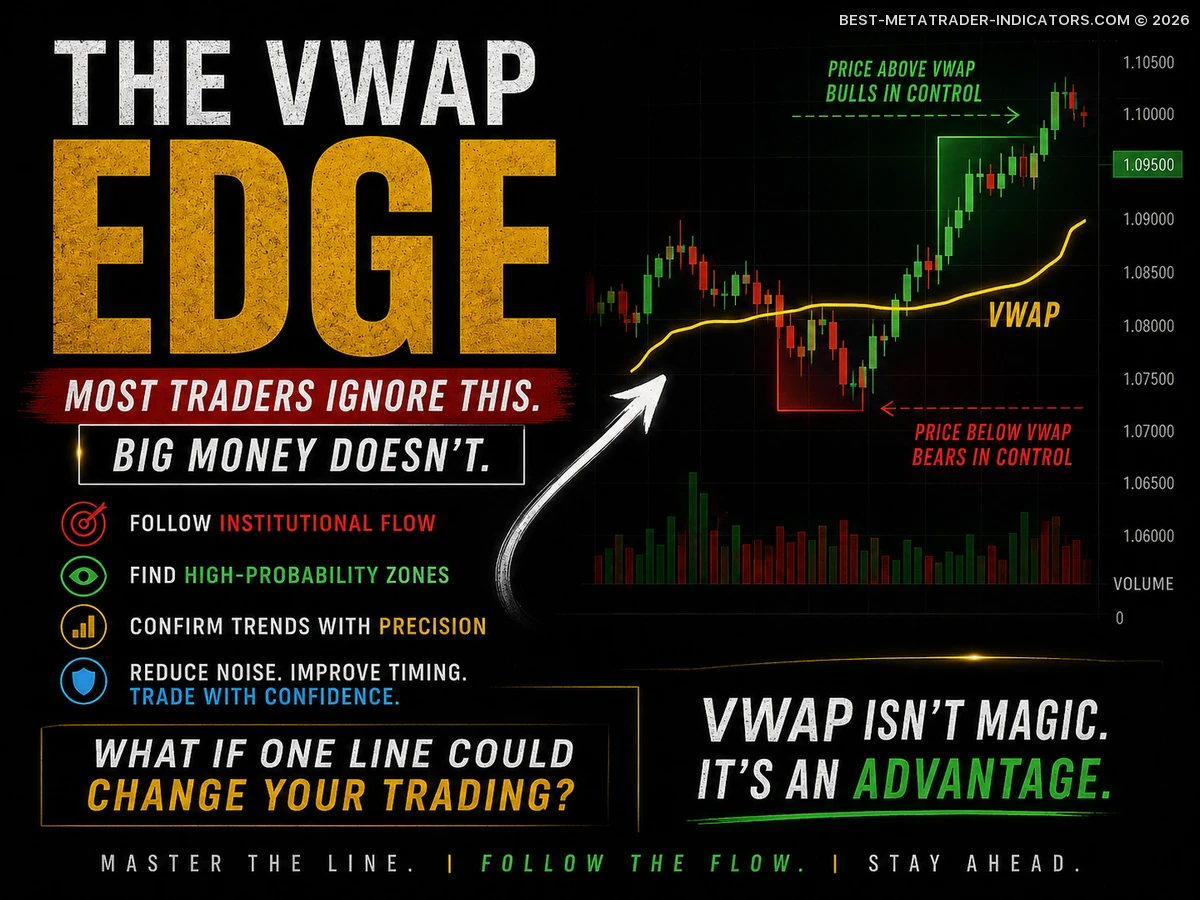
VWAP, or Volume Weighted Average Price, is more than another line added to a trading chart. Used with discipline, it becomes a practical benchmark for fair value, execution quality, trend bias, and intraday trade location. In Forex, where traders usually work with tick volume rather than centralized exchange volume, VWAP still has real value when it is applied with realistic expectations and a structured trading process.
This article explains VWAP from a trader’s point of view: what it measures, how it behaves during active sessions, where it helps, where it misleads, and how to build practical Forex strategies around it without treating it like a guaranteed signal.
📌 What Is VWAP?
VWAP stands for Volume Weighted Average Price. It measures the average price of an instrument over a chosen period, weighted by trading activity. In practical terms, VWAP answers one useful question: where has the market accepted value during this session?
Unlike a simple moving average, which treats every price print equally, VWAP gives more weight to prices where more activity occurred. That makes it useful as a dynamic value line, especially for intraday traders who care about entry location, liquidity, and whether price is trading above, below, or directly around fair value.
💡 Trader’s Note
VWAP is not designed to predict the next candle. Its strength is context. It helps you judge whether price is trading above value, below value, or rotating around the session’s weighted average.
🧮 How VWAP Is Calculated
The standard VWAP calculation uses typical price multiplied by volume, divided by total volume over the selected period. On many Forex platforms, the volume input is tick volume, so the line reflects activity from that broker or data feed rather than global spot FX turnover.
VWAP Formula
VWAP = Σ (Typical Price × Volume) ÷ Σ Volume
Typical Price is often calculated as:
(High + Low + Close) ÷ 3
For example, if most EUR/USD activity during the London session develops around 1.0850, VWAP will tend to stay close to that area. If price pushes sharply higher but the activity profile does not support the move, VWAP may remain lower, warning traders that price is stretched and that a pullback toward value is possible.
🌍 VWAP in Forex: What Makes It Different?
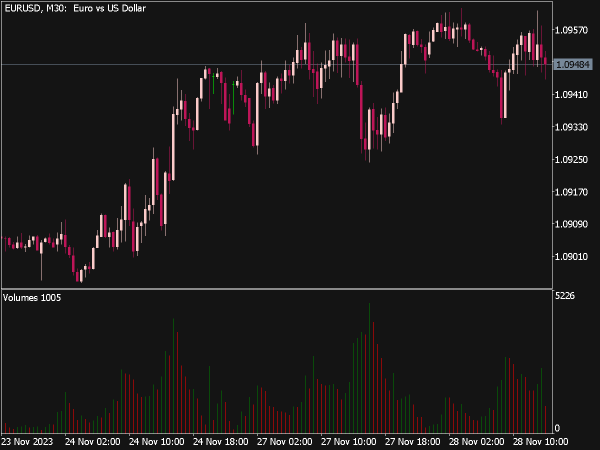
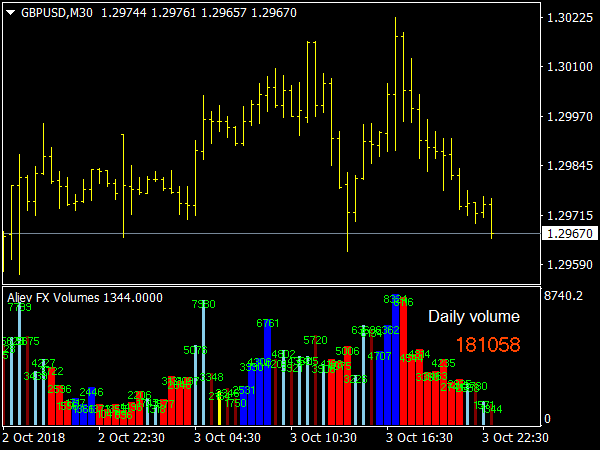
VWAP became popular in markets with centralized exchange volume, such as stocks and futures. Spot Forex is decentralized, so there is no single global volume feed available to most retail traders. MetaTrader platforms and many retail feeds usually rely on tick volume, which counts price changes rather than the exact number of traded units.
That does not make VWAP useless in Forex. It simply means the trader must understand what the data represents. Tick volume can still be a practical activity proxy, especially on major pairs during liquid sessions, but it should be treated as a guide to participation rather than a perfect institutional volume record.
| Market | Volume Source | VWAP Reliability | Best Use |
|---|---|---|---|
| Stocks | Centralized exchange volume | High | Execution benchmark, activity-weighted value, intraday order flow context |
| Futures | Exchange volume | High | Intraday value, trend bias, mean reversion, pullback planning |
| Spot Forex | Broker tick volume | Moderate | Session bias, pullback zones, liquidity reactions, MetaTrader strategy filters |
| Crypto | Exchange-specific volume | Variable | Trend confirmation, execution zones, activity-based value areas |
🎯 Why Professional Traders Watch VWAP
VWAP is popular because it gives traders a clean reference point. Larger participants often compare execution quality with VWAP because it shows whether an entry was achieved near the session’s weighted value or at an unfavorable distance from it.
For active traders, VWAP helps identify whether the market is accepting higher prices, rejecting lower prices, or simply rotating around a balanced value zone. That distinction matters because the same VWAP touch can be a continuation opportunity in one market and a trap in another.
Trend Bias
Price holding above VWAP often suggests buyers have control. Price holding below VWAP often suggests sellers dominate the session.
Fair Value
VWAP acts as a dynamic fair-value line. Pullbacks toward it can offer cleaner trade location than chasing extended candles.
Risk Control
VWAP helps traders avoid late entries when price is already stretched and the Stop Loss distance no longer makes sense.
⚙️ Anchored VWAP vs Session VWAP
There are two common ways to use VWAP: session VWAP and anchored VWAP. Both are useful, but they answer different trading questions and should not be applied randomly.
Session VWAP focuses on the current trading session. Anchored VWAP starts from a specific candle, swing point, breakout, or structural shift.
| Type | What It Measures | Best For | Common Mistake |
|---|---|---|---|
| Session VWAPResets daily or by session | Intraday average value | Day trading, London/New York sessions, MetaTrader intraday setups | Using it during quiet periods with poor liquidity and narrow ranges |
| Anchored VWAPStarts from a chosen candle or event | Average value since a major high, low, breakout, failed breakout, or impulse candle | Swing context, structural validation, trend continuation, reversal testing | Anchoring it randomly without market-structure logic |
📈 Strategy 1: VWAP Trend Pullback
This is one of the cleanest VWAP strategies for Forex traders. Instead of buying every breakout or selling every breakdown, the trader waits for price to establish directional bias and then pull back toward VWAP.
Setup Rules
- Choose a liquid pair such as EUR/USD, GBP/USD, USD/JPY, or XAU/USD.
- Trade during active sessions, preferably London, New York, or the session overlap.
- Identify price trading clearly above VWAP for long bias or below VWAP for short bias.
- Wait for a pullback toward VWAP instead of chasing the first breakout candle.
- Look for confirmation: rejection wick, structure break, bullish or bearish engulfing candle, higher low, lower high, or support/resistance reaction.
- Place the Stop Loss beyond the pullback structure, not exactly on VWAP where normal noise can trigger it.
- Plan Take Profit near the prior high or low, the next liquidity area, or a measured risk-to-reward level.
The logic is simple: in a healthy trend, VWAP often acts like a value magnet. Skilled traders prefer buying value in an uptrend and selling value in a downtrend. The goal is not to be early. The goal is to enter where risk is defined, the Stop Loss is logical, and price still has room to move toward a realistic Take Profit area.
🔁 Strategy 2: VWAP Mean Reversion
VWAP can also be used for mean reversion when price stretches too far from fair value. This approach works best in range-bound markets, after emotional price expansion, or when a session spike fails to attract continuation.
⚠️ Warning
Mean reversion against a strong trend can be dangerous. A market can stay extended much longer than expected, especially when momentum is clean, spreads widen, or traders keep adding in the direction of the move.
Mean Reversion Checklist
- Price is far away from VWAP after a fast move.
- The move shows exhaustion candles, long wicks, or failure to continue.
- There is a nearby support or resistance level, round number, prior swing point, or liquidity zone.
- Momentum starts to slow down, candles lose range, or price fails to print a clean continuation structure.
- The Take Profit target is realistic: VWAP or partial mean reversion, not the opposite side of the chart.
🧭 Strategy 3: Anchored VWAP After a Volatility Impulse
Forex markets often move aggressively after a breakout, failed breakout, liquidity sweep, or sudden expansion from a tight range. Anchored VWAP can help traders measure whether the new price area is being accepted or rejected.
Anchor VWAP at the first major impulse candle, the breakout candle, or the swing point that started the move. If price stays above anchored VWAP after a bullish expansion, buyers may be defending the new value area. If price loses anchored VWAP and fails to reclaim it, the initial move may be fading and trapped traders may begin to exit.
Bullish Acceptance
Price breaks higher, pulls back to anchored VWAP, and holds above it. This can signal that buyers are accepting higher value and defending the structure.
Breakout Fade
Price spikes higher, falls back below anchored VWAP, and rejects the retest. This can signal trapped buyers, weak continuation, and reversal risk.
🛠️ Practical VWAP Trading Ideas
VWAP becomes more useful when combined with market structure, session timing, and liquidity. Here are practical ways to use it without cluttering the chart or turning the setup into a mechanical signal.
| Idea | How to Use It | Best Market Condition |
|---|---|---|
| VWAP Bounce | Enter after price rejects VWAP in the direction of the dominant intraday structure. | Trending sessions |
| VWAP Break and Retest | Wait for price to cross VWAP, retest it, and confirm continuation with structure. | Reversal or session shift |
| VWAP Compression | Watch price coil around VWAP before a breakout, then wait for acceptance outside the range. | Pre-breakout or range markets |
| VWAP Distance Filter | Avoid entries when price is too far from VWAP and the Stop Loss would be too wide. | All intraday conditions |
✅ VWAP Trading Checklist
Before Entering a VWAP Trade, Ask:
- Is the pair liquid right now?
- Are we trading during London, New York, or an active overlap?
- Is price clearly above, below, or rotating around VWAP?
- Does market structure support the trade direction?
- Is there enough room to the next support, resistance, or liquidity area?
- Is my Stop Loss based on structure rather than emotion?
- Is my Take Profit realistic compared with the current range and volatility?
- Am I buying value in an uptrend or selling value in a downtrend?
- Am I avoiding a new entry when spread, volatility, or candle size makes execution poor?
📊 VWAP vs Moving Average
Many traders ask whether VWAP is better than a moving average. The better answer is that they do different jobs. A moving average smooths price over time. VWAP measures price in relation to activity-weighted value. They can look similar on the chart, but they do not carry the same information.
| Feature | VWAP | Moving Average |
|---|---|---|
| Main Input | Price and volume or tick volume | Price only |
| Best Use | Intraday value, execution benchmark, session bias, pullback filtering | Trend smoothing, dynamic support/resistance, directional context |
| Resets | Usually daily, session-based, or anchored from a selected point | Continuously rolls over the selected number of periods |
| Weakness | Less reliable in low-activity conditions or poor-quality tick data | Can lag heavily and ignore where meaningful activity occurred |
👍 Advantages of VWAP
Clear Trade Location
VWAP helps traders avoid emotional entries by showing whether price is close to or far from session value.
Useful Bias Filter
Price above VWAP often supports a bullish intraday bias. Price below VWAP often supports a bearish bias.
Works With Structure
VWAP combines well with support, resistance, liquidity sweeps, session highs and lows, and candlestick confirmation.
Simple but Powerful
It gives traders one clean benchmark instead of forcing the chart to carry too many indicators at once.
👎 Disadvantages of VWAP
Not a Signal by Itself
Touching VWAP is not automatically a buy or sell signal. Context, structure, and execution quality matter.
Forex Volume Limitation
Spot Forex uses broker-specific tick volume, so VWAP is only as good as the MetaTrader data feed behind it.
Weak in Choppy Markets
When price rotates around VWAP without direction, it can create false entries and poor reward-to-risk conditions.
Difficult During Fast Spikes
During sudden volatility, spreads, slippage, and large candles can make VWAP levels less dependable for precise entries.
🧠 Professional Tips for Using VWAP
- Use VWAP as context, not as a trigger. Let price action confirm the trade.
- Trade VWAP during liquid sessions. London and New York usually provide cleaner reactions than quiet range conditions on many pairs.
- Do not chase price far from VWAP. If the market is extended, wait for a pullback or accept that the trade is gone.
- Combine VWAP with market structure. A VWAP bounce at prior resistance-turned-support is stronger than a random VWAP touch.
- Respect the higher timeframe. Intraday VWAP longs are lower quality when the higher timeframe is pressing into major resistance.
- Anchor VWAP logically. Use major highs, lows, breakouts, failed breakouts, swing points, or session opens. Do not anchor it randomly.
- Journal screenshots. Save examples of clean VWAP reactions and failed reactions. Pattern recognition improves when you review real trades instead of relying on memory.
📝 Trading Journal Prompt
After each VWAP trade, record whether price was above, below, or rotating around VWAP; whether the entry was near value or extended; where the Stop Loss and Take Profit were placed; and whether the trade respected session direction. This turns VWAP from a line into a repeatable decision tool.
🚫 Common VWAP Mistakes
- Buying just because price touches VWAP. A touch is not a setup.
- Using VWAP in isolation. Always consider structure, volatility, session, spread, and candle quality.
- Ignoring execution. Slippage and spread matter, especially on exotic pairs and during sudden volatility.
- Shorting every move above VWAP. In strong trends, price can stay above VWAP for hours.
- Using the same VWAP logic on every pair. EUR/USD, GBP/JPY, and gold all move differently and need different expectations.
🧩 A Simple VWAP Trading Plan Template
VWAP Plan Example
Market: EUR/USD
Session: London open to New York overlap
Bias Rule: Long only if price holds above session VWAP and higher-timeframe structure is not bearish.
Entry Rule: Wait for a pullback toward VWAP, then enter only after rejection and bullish structure confirmation.
Stop Loss Rule: Place the Stop Loss below the pullback swing low, not directly below VWAP.
Take Profit Rule: First Take Profit at the prior session high or 1.5R; second target can trail behind structure.
No-Trade Rule: No new entry when spread, candle size, or volatility makes the planned reward-to-risk unattractive.
❓ VWAP FAQs
Is VWAP good for Forex trading?
Yes, but it must be used correctly. Since spot Forex uses tick volume rather than centralized exchange volume, VWAP should be treated as a practical value guide, not a perfect institutional volume measure.
Which timeframe works best with VWAP?
VWAP is most useful for intraday trading on timeframes such as 1-minute, 5-minute, 15-minute, and 30-minute charts. Higher timeframes can benefit from anchored VWAP when the anchor point is chosen from clear structure.
Can VWAP be used for scalping?
Yes. Scalpers often use VWAP to identify short-term bias, avoid poor entries, and trade pullbacks during active sessions. The setup still needs a defined Stop Loss and realistic Take Profit.
Is VWAP better than RSI or MACD?
It is different, not necessarily better. RSI and MACD measure momentum. VWAP measures price relative to activity-weighted value. Many traders combine them carefully, especially on MetaTrader charts.
Should I buy when price is above VWAP?
Not automatically. Price above VWAP can suggest bullish bias, but you still need structure, timing, risk control, and confirmation.
What is the biggest VWAP mistake?
The biggest mistake is treating VWAP as a standalone signal. VWAP works best as a decision filter inside a complete trading plan with entry rules, Stop Loss logic, Take Profit planning, and trade review.
🏁 Final Thoughts
VWAP is not a holy grail, but it is one of the most practical tools a Forex trader can add to the chart. It helps answer a question serious traders should ask before entering a position: am I trading near value, or am I chasing price?
Used with session awareness, market structure, liquidity, Stop Loss placement, Take Profit planning, and disciplined risk management, VWAP can improve trade selection and reduce impulsive decisions. The best traders do not use VWAP to predict every candle. They use it to understand where price is trading in relation to value, and that can make the difference between a planned trade and a poor reaction.
Risk disclaimer: Trading Forex and CFDs involves risk. Technical indicators such as VWAP can support analysis, but they do not guarantee profitable trades. Always use a defined Stop Loss, plan your Take Profit before entry, manage position size carefully, and trade only with capital you can afford to lose.