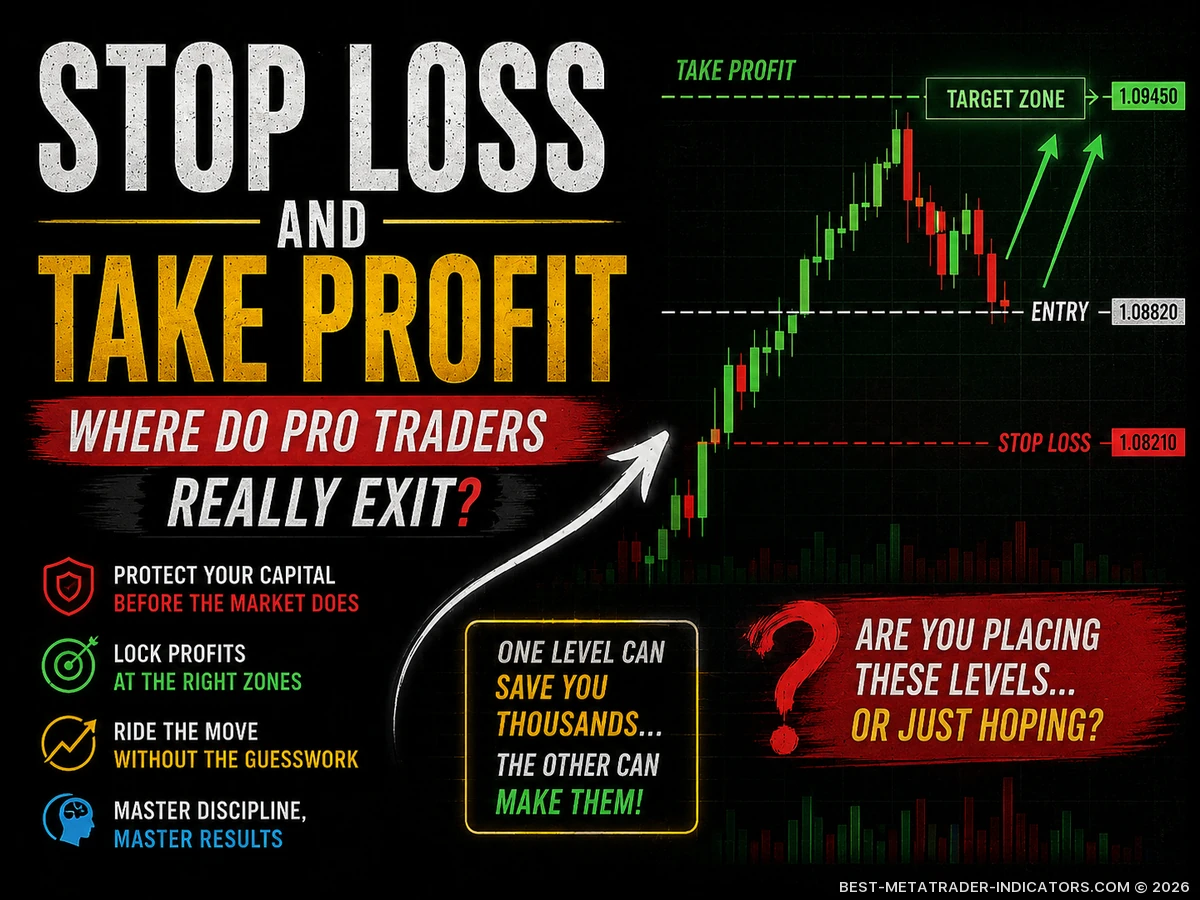
Every Forex trader likes talking about entries. The clean breakout. The patient pullback. The sharp entry after a liquidity sweep. After enough time in live markets, though, one lesson becomes hard to ignore: your entry gets you into the trade, but your exit decides whether you survive long enough to become good.
A Stop Loss and Take Profit plan is where strategy becomes discipline. It turns hope into structure, emotion into rules, and random risk into measurable decision-making. Below, we work through how serious traders think about Stop Loss and Take Profit levels, how they place them, how they avoid common exit mistakes, and how a repeatable Forex exit framework can be built without overcomplicating the trade.
🛡️ What Is a Stop Loss?
A Stop Loss is a protective order that closes a trade when price moves against your position by a predefined amount. In practical trading terms, it marks the point where your original trade idea has failed enough to step aside.
Many beginners see the Stop Loss as “where I lose money.” Experienced traders read it differently. A Stop Loss is the cost of information. It tells you that the market did not confirm your idea, and it protects your trading capital from one poor decision turning into a damaging one.
💡 Trader’s Note
A good Stop Loss is not placed where you can emotionally tolerate the loss. It is placed where the trade setup is logically invalidated.
🎯 What Is a Take Profit?
A Take Profit order closes a trade when price reaches your planned profit target. It allows you to secure gains without negotiating with yourself while the candles are still moving.
Without a Take Profit plan, traders often fall into two traps: they close winning trades too early because they fear giving back profit, or they hold winners too long because greed convinces them that “just a little more” is coming.
✅ The Real Purpose of Take Profit
Take Profit is not about predicting the exact market top or bottom. It is about exiting at a logical area where the reward is attractive and the probability of continuation may start to decrease.
⚖️ Stop Loss vs Take Profit: The Core Difference
Both orders define the trade before emotion takes control — but they serve opposite purposes.
| Element | Stop Loss | Take Profit | Trader’s Question |
|---|---|---|---|
| PurposeRisk protection | Limits downside when the trade is wrong | Locks in upside when the trade works | Where is my idea invalid? |
| Emotion ControlledFear and hope | Prevents holding losers forever | Prevents greed from erasing gains | What will I do before emotions rise? |
| Placement LogicMarket structure | Beyond support, resistance, swing high/low, volatility zone | Near liquidity, resistance/support, measured move, risk-reward target | What level makes objective sense? |
| Main MistakePoor planning | Placed too tight or moved farther away | Placed randomly or constantly canceled | Am I following a plan or reacting? |
📌 Why Stop Loss and Take Profit Matter More Than Most Traders Think
In Forex, you can have a win rate below 50% and still be profitable if your average winners are larger than your average losers. You can also have a high win rate and still lose money if your losing trades are too large. That is why Stop Loss and Take Profit are not technical details — they define the mathematical engine of your trading system.
🧠 They Reduce Emotional Trading
Predefined exits remove the need to make critical decisions while price is moving fast and emotions are high.
📊 They Make Results Measurable
When risk and reward are planned in advance, you can evaluate whether your strategy has a real edge.
🧱 They Protect Longevity
The goal is not to win one trade. The goal is to stay in the game long enough for your edge to play out.
📐 The Risk-Reward Ratio: Your Trading Compass
The risk-reward ratio compares how much you are willing to risk against how much you aim to make. If you risk 50 pips to target 100 pips, the trade has a 1:2 risk-reward ratio. That means one winning trade can cover two losing trades of the same size.
| Risk | Target | Risk-Reward Ratio | Meaning |
|---|---|---|---|
| 30 pips | 30 pips | 1:1 | You need a higher win rate to stay profitable. |
| 30 pips | 60 pips | 1:2 | A balanced structure for many swing and intraday traders. |
| 30 pips | 90 pips | 1:3 | Powerful, but usually requires more patience and fewer winning trades. |
| 50 pips | 25 pips | 2:1 | Often dangerous unless supported by a very high-probability system. |
⚠️ Important Warning
A high risk-reward ratio looks attractive on paper, but it must match the market condition. A 1:5 target in a quiet range can be unrealistic. A 1:1 target in a strong trend may leave too much money on the table.
🧭 How to Place a Stop Loss Like a Professional
Professional traders do not place Stop Loss orders randomly. They use structure, volatility, liquidity, and invalidation logic. The methods below are practical because they start from the chart, not from fear.
1️⃣ Structure-Based Stop Loss
Place the Stop Loss beyond a recent swing high or swing low. If you buy after a bullish pullback, your Stop Loss may go below the pullback low. If price breaks that level, the setup may no longer be valid.
- Best for trend-following setups
- Works well with support and resistance
- Helps avoid random stop placement
2️⃣ Volatility-Based Stop Loss
Use market volatility to avoid placing the Stop Loss too close. Traders often use Average True Range concepts to estimate how much a pair normally moves.
- Useful during active sessions
- Helps reduce premature stop-outs
- Good for pairs with different volatility profiles
3️⃣ Time-Based Stop Loss
Sometimes the problem is not price movement, but lack of movement. If a trade does not develop after a certain period, closing it can free your capital and attention.
- Useful for session-based day trading
- Prevents dead trades from draining focus
- Works best with clear entry timing rules
4️⃣ Invalidation-Based Stop Loss
This is the most professional mindset: ask, “At what price is my analysis no longer valid?” Your Stop Loss belongs beyond that point, with a small buffer.
- Encourages objective planning
- Works across most strategies
- Reduces emotional decision-making
🎯 How to Set Take Profit Targets
Take Profit placement should be just as logical as Stop Loss placement. The best targets are not based on what you want from the trade. They are based on how price usually behaves around structure, liquidity, and momentum.
📍 Support and Resistance Targets
If you are buying, look for the next resistance area where sellers may appear. If you are selling, look for the next support area where buyers may defend price.
💧 Liquidity-Based Targets
Price often moves toward obvious highs, lows, and stop clusters. These areas can become attractive Take Profit zones, especially in trending or breakout conditions.
📏 Measured Move Targets
Use the size of a range, consolidation, or previous impulse move to project a realistic target. This can help avoid arbitrary exits.
⚖️ Fixed Risk-Reward Targets
Some traders use fixed targets such as 1:1.5, 1:2, or 1:3. This keeps the system consistent and makes performance easier to review.
🧪 Example Trade Plan: EUR/USD Pullback Setup
Imagine EUR/USD is trending higher. Price pulls back into a previous resistance area that now behaves as support. A bullish reaction candle forms, and you plan a long trade.
| Trade Element | Example Decision | Reasoning |
|---|---|---|
| Entry | Buy after bullish confirmation | Trend continuation setup after pullback |
| Stop Loss | Below the pullback low | If price breaks this low, the bullish structure weakens |
| Take Profit 1 | Previous swing high | Logical first area where sellers may appear |
| Take Profit 2 | Next resistance or liquidity zone | Allows part of the position to run if momentum continues |
| Management | Move Stop Loss only according to plan | Avoid emotional stop movement |
🧠 Professional Mindset
The goal is not to be right on every trade. The goal is to make sure that when you are wrong, the loss is controlled — and when you are right, the reward is worth the risk.
🧩 Fixed vs Dynamic Stop Loss and Take Profit
There are two main ways to manage exits: fixed and dynamic. Both can work, but they suit different trader personalities, time frames, and market conditions.
Choosing the right approach depends on your strategy, time frame, and emotional discipline.
| Approach | How It Works | Advantages | Disadvantages | Best For |
|---|---|---|---|---|
| Fixed SL/TPPredefined levels | You set both orders before entering and rarely adjust them. | Simple, consistent, easy to backtest. | May ignore changing market conditions. | Beginners, mechanical systems, backtested strategies. |
| Dynamic SL/TPAdaptive management | You adjust exits based on structure, volatility, or price action. | Flexible and responsive to live market behavior. | Can become emotional without strict rules. | Experienced discretionary traders. |
| Partial ProfitsScale out method | You close part of the position at one target and let the rest run. | Locks in profit while keeping upside open. | Can reduce total reward if used too early. | Trend traders and swing traders. |
| Trailing StopProfit protection | The Stop Loss follows price as the trade moves in your favor. | Can capture large moves. | May exit too early in choppy markets. | Trending markets and breakout trades. |
🚦 Popular Stop Loss Strategies
🔹 Swing High / Swing Low Stop
This is one of the cleanest methods. In a long trade, place the Stop Loss below the latest swing low. In a short trade, place it above the latest swing high.
Why it works: it uses real market structure instead of arbitrary pip distances.
🔹 Breakout Retest Stop
After a breakout and retest, the Stop Loss can be placed behind the retest zone. If price returns deep into the old range, the breakout idea may be failing.
Why it works: it gives the breakout room while protecting against false continuation.
🔹 ATR-Style Volatility Stop
The Stop Loss is based on current volatility rather than a fixed number of pips. More volatile pairs need more breathing room; quieter pairs may need less.
Why it works: it adapts to market movement instead of forcing every pair into the same box.
🔹 Session High / Low Stop
Day traders often use the London or New York session high or low as a reference. A break beyond that level can signal that the intraday idea has failed.
Why it works: it aligns the Stop Loss with session-based liquidity.
🏁 Popular Take Profit Strategies
💰 1:2 Risk-Reward Target
A classic approach: if you risk 40 pips, you target 80 pips. This keeps your system mathematically attractive even if not every trade wins.
📌 Previous Highs and Lows
Major swing points often attract orders. Taking profit near those zones can be more realistic than waiting for a perfect extended move.
🧱 Support and Resistance Zones
Instead of targeting one exact price, treat support and resistance as zones. This can prevent missing a Take Profit by only a few pips.
🚀 Runner Position
Close part of the position at a conservative target and let the rest run with a trailing stop. This can help capture rare but powerful trends.
✅ Stop Loss and Take Profit Checklist Before Entering a Trade
Before clicking buy or sell, run through this checklist. It may feel slow at first, but that short pause can prevent months of avoidable frustration.
📋 Pre-Trade Checklist
- Do I know exactly where my Stop Loss goes?
- Is my Stop Loss based on market structure, not fear?
- Do I know my Take Profit level before entering?
- Is the potential reward worth the risk?
- Have I calculated the correct position size?
- Is the current volatility suitable for my Stop Loss distance?
- Does this trade match my written trading plan?
- Am I entering because of a setup, not because I feel bored or impatient?
🚫 Common Mistakes Traders Make
❌ Moving the Stop Loss Farther Away
This is one of the most expensive habits in Forex. It turns a planned loss into an emotional negotiation with the market.
❌ Placing Stops Too Tight
A tight Stop Loss may look safe, but if it sits inside normal market noise, you may be stopped out before the setup has a fair chance.
❌ Taking Profit Too Early
Closing every winner at the first sign of profit can destroy your risk-reward profile, even if your win rate feels good.
❌ Using the Same Pip Stop on Every Pair
EUR/USD, GBP/JPY, XAU/USD, and USD/CHF do not move the same way. Your exit logic should respect volatility.
🧠 The Psychology Behind Stop Loss and Take Profit
Most exit mistakes are psychological. Traders move stops because they do not want to admit they are wrong. They close winners early because they fear losing open profit. They cancel Take Profit orders because they imagine a bigger move. They widen Stop Loss orders because they hope price will come back.
But the market does not reward hope. It rewards preparation, patience, and consistency. Your Stop Loss and Take Profit are psychological anchors. They keep you attached to your plan when your emotions want to take over.
Good trading is not about avoiding losses. It is about keeping losses small enough and winners meaningful enough that the overall system can grow.
📊 Advantages and Disadvantages
✅ Advantages
- Protects capital from oversized losses
- Creates a structured trading plan
- Improves emotional discipline
- Makes performance easier to track
- Supports consistent position sizing
- Helps avoid revenge trading after losses
⚠️ Disadvantages
- Stops can be triggered before price reverses
- Targets can be missed by a few pips
- Poor placement can reduce strategy performance
- Rigid targets may ignore strong trend conditions
- Sudden volatility spikes can cause slippage in fast markets
- Over-management can become another emotional trap
🛠️ Practical Tips From Experienced Forex Traders
🔎 Tip 1: Think in R, Not Only in Pips
If your Stop Loss risk equals 1R, then a 2R target means you aim to make twice what you risk. This makes it easier to compare trades across different pairs and time frames.
🕒 Tip 2: Respect the Trading Session
A Stop Loss that works during the Asian session may be too tight during London open. Volatility changes throughout the day, and your trade management should recognize that.
📓 Tip 3: Journal Every Exit
Do not only record entries. Record why you exited, whether you followed your plan, and what happened after the exit. Over time, your journal will show whether your Stop Loss and Take Profit rules are improving the strategy or quietly damaging it.
🧘 Tip 4: Accept That Good Stops Still Lose
A Stop Loss being hit does not automatically mean the setup was bad. It may simply be one trade in a large sample. Judge your exit strategy over many trades, not one emotional moment.
🧮 Position Sizing: The Missing Link
A Stop Loss only protects you properly if your position size is correct. A 20-pip Stop Loss can be conservative or reckless depending on lot size. The professional question is not “How many pips can I risk?” but “How much of my account is at risk if the Stop Loss is hit?”
| Account Risk Style | Risk Per Trade | Comment |
|---|---|---|
| Conservative | 0.25%–0.5% | Useful for beginners, recovery phases, or uncertain market conditions. |
| Balanced | 0.5%–1% | Common among disciplined traders who value consistency. |
| Aggressive | 1%–2% | Can grow faster but also creates larger drawdowns. |
| Danger Zone | Above 2% | Requires exceptional discipline and can become psychologically difficult. |
🚨 Risk Reminder
Never increase lot size just because a Stop Loss looks small. A smaller Stop Loss does not automatically mean a safer trade if the position size is too large.
📈 Should You Move Your Stop Loss to Break Even?
Moving a Stop Loss to break even is popular, but it is often misunderstood. It can protect capital, but it can also remove you from trades too early if done without logic.
✅ When It Makes Sense
- Price has reached a meaningful structure level
- The trade has moved at least 1R in your favor
- Market momentum is slowing near your first target
- Your strategy specifically includes break-even management
⚠️ When It Can Hurt
- You move to break even too quickly
- You use it because you are afraid
- Normal pullbacks keep stopping you out
- You have not tested the rule over many trades
📚 A Simple Exit Framework You Can Test
Here is a simple framework you can adapt to your own strategy. Do not use it blindly; test it, journal it, and adjust it to the instrument, session, and time frame you actually trade.
🧩 The 4-Step Exit Framework
- Define invalidation: decide where the trade idea is wrong.
- Calculate position size: risk only a planned percentage of your account.
- Set the first target: use a realistic support/resistance or 1R–2R area.
- Plan management: decide in advance whether you will trail, scale out, or leave the trade untouched.
🧾 Stop Loss and Take Profit Rules for Beginners
If you are still developing consistency, keep your rules simple. Complexity often gives beginners more room to interfere with trades after entry.
✅ Beginner Rules
- Never enter a trade without a Stop Loss.
- Never widen a Stop Loss after entry.
- Do not risk more than your written plan allows.
- Use Take Profit levels based on structure, not wishful thinking.
- Do not cancel Take Profit because of greed.
- Review at least 20–50 trades before judging your exit rules.
- Keep screenshots of entry, Stop Loss, Take Profit, and final result.
🤔 FAQ: Stop Loss and Take Profit
❓ Is a Stop Loss always necessary in Forex?
For most traders, yes. Forex can move quickly, especially around liquidity sweeps, volatility expansions, and session opens. A Stop Loss helps define risk before the market tests your emotions.
❓ What is the best Stop Loss distance?
There is no universal number. The best distance depends on market structure, volatility, time frame, and your position size.
❓ Should I use a fixed Take Profit?
A fixed Take Profit can be helpful for consistency, especially for beginners. Advanced traders may use dynamic targets, partial exits, or trailing stops.
❓ Why does price often hit my Stop Loss and then reverse?
Your Stop Loss may be too close, placed at an obvious liquidity level, or not aligned with market volatility. Review whether you are placing stops where many traders place them.
❓ Is 1:2 risk-reward always better than 1:1?
Not always. A 1:2 ratio is attractive, but it must match the strategy’s probability. A lower target with a much higher win rate can still work if tested properly.
❓ Should I move my Stop Loss to break even?
Only if your rules support it. Moving to break even too early can protect the account but damage the strategy by cutting good trades prematurely.
🏆 Final Thoughts: Exits Are Where Traders Mature
Stop Loss and Take Profit are not boring technical settings. They are the language of professional trading. They tell you how much you are willing to lose, where you expect to be rewarded, and whether your trade is worth taking at all.
Many traders spend years looking for a perfect entry signal. The more experienced you become, the more you understand that the real edge often comes from risk control, exit discipline, and consistent execution.
🚀 The Key Takeaway
A profitable trader does not need to predict every move. A profitable trader needs a plan that keeps losses controlled, lets good trades pay, and can be repeated without emotional chaos.
Before your next Forex trade, ask yourself one simple question: “If I am wrong, where do I exit — and if I am right, where do I get paid?”
Disclaimer: This article is for educational purposes only and does not constitute financial advice. Forex trading involves risk, including the loss of capital, and past performance does not guarantee future results.